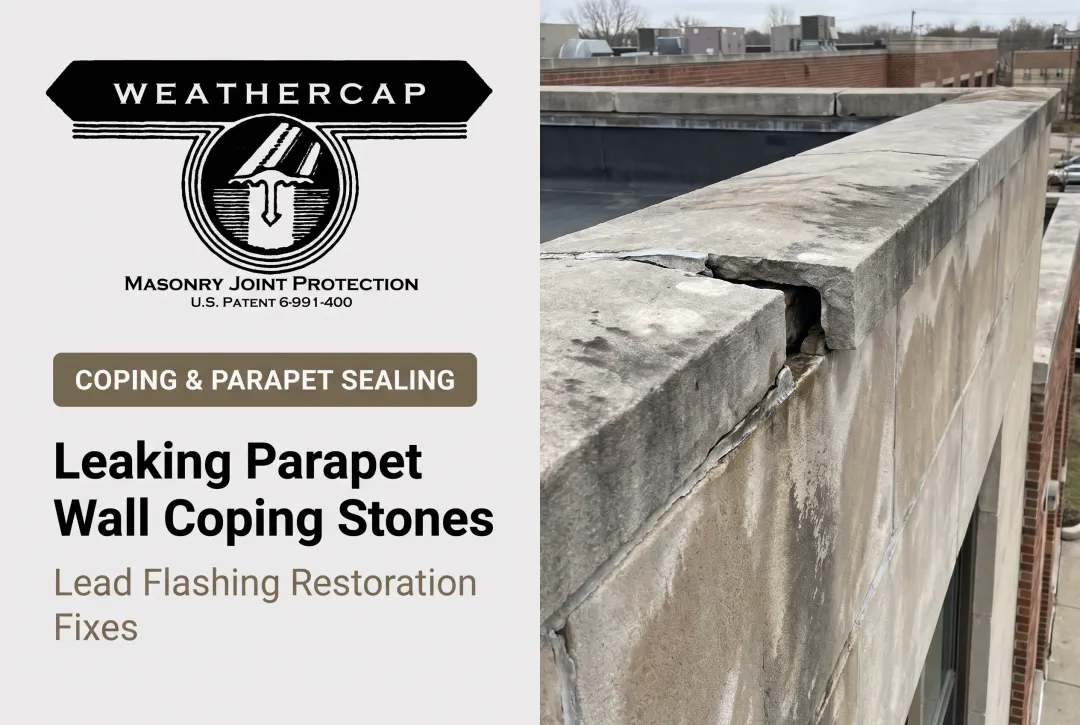

Many building owners assume coping stones themselves are the waterproofing barrier. They're not. The real defense is the joint between each stone, and when that joint fails, water finds its way into the wall assembly. The result: efflorescence, staining, and interior damage that can appear far from where the leak actually started.
This guide breaks down why coping joints fail, compares the sealing materials available, and covers proven methods used on federal landmarks and modern buildings alike.
Key Takeaways
- Joint-sealing method—not the stone—keeps coping stones watertight
- Mortar, polyurethane, silicone, and lead strip systems absorb building movement at very different rates
- Most joint failures trace to building movement rather than poor workmanship
- GSA Historic Preservation procedures specify patented systems like WEATHERCAP® for long-term joint protection
Why Parapet Coping Waterproofing Is So Challenging
Coping stones cap the wall, but they don't work alone. Beneath most stone or precast coping is a dowel anchor that penetrates the waterproofing membrane below. That penetration point is a known leak risk flagged repeatedly by building enclosure engineers, since any dowel that pierces the waterproofing layer creates a potential water entry path. Building movement makes it worse. Brick expands, CMU shrinks, and parapets lean. One IIBEC case study documented roughly 1.2 inches of differential movement between a CMU backup wall and brick veneer: 0.9 inches of brick expansion and 0.3 inches of CMU shrinkage. The same structure showed parapet inward lean of 4 to 6 inches. Sealants have a designed stretch limit. When movement exceeds that limit, the joint opens and water gets in.

The Domino Effect of a Failed Joint
Once water breaches a coping joint, it doesn't stay put:
- Travels laterally inside the wall cavity, often for several feet
- Surfaces as interior staining far from the actual entry point
- Accelerates freeze-thaw cracking in adjacent masonry
- Feeds efflorescence and biological growth on exterior faces A 2013 peer-reviewed study on historical masonry structures identified dampness as the primary driver of masonry deterioration. Moisture control at the coping joint isn't cosmetic maintenance. It's structural protection.
Comparing Coping Joint Sealing Materials
Not all joint-filling methods perform the same under stress. Here's how the main options stack up:
| Material | Strengths | Weaknesses |
|---|---|---|
| Mortar | Low cost, traditional look | Cracks under movement; no flexibility |
| Polyurethane sealant | Affordable, tear-resistant, up to ±35% movement | UV degradation over time |
| Silicone sealant | Strong UV resistance, ±25%+ movement | Can stain adjacent natural stone |
| Lead strip system | Absorbs stress; resists corrosion and mold; long service life | Requires proper handling precautions |

Mortar is the cheapest option upfront, but it's rigid. When the joint moves, mortar cracks rather than flexes. A cracked joint is an open joint.
Polyurethane sealants, such as Sika's Sikaflex NP 1, offer solid tear resistance and a movement capability rated at ±35%. The tradeoff is UV degradation. Sky-facing coping joints get more direct sun exposure than almost any other detail on the building, which accelerates that breakdown.
Silicone sealants hold up better against UV. Dow's DOWSIL SJ-169, for example, is rated for ±25% movement and marketed as non-staining on natural stone. Other silicone formulations reach even higher movement ranges. The risk with some silicones is staining on porous stone, so product selection matters.
Where Lead Strip Systems Fit
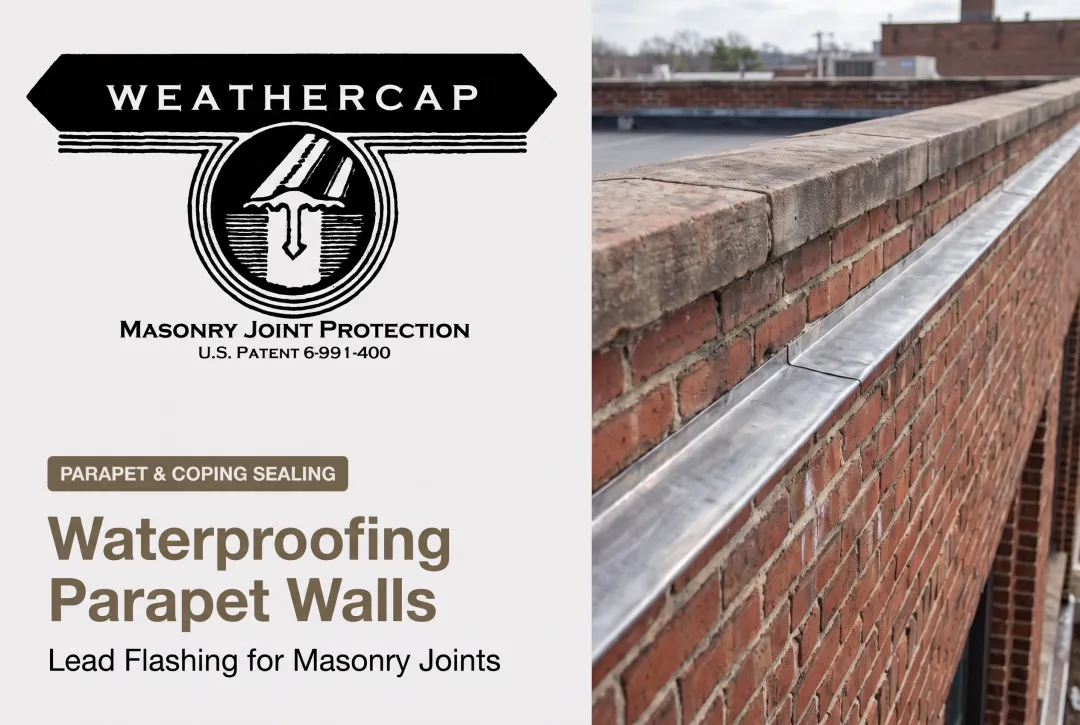
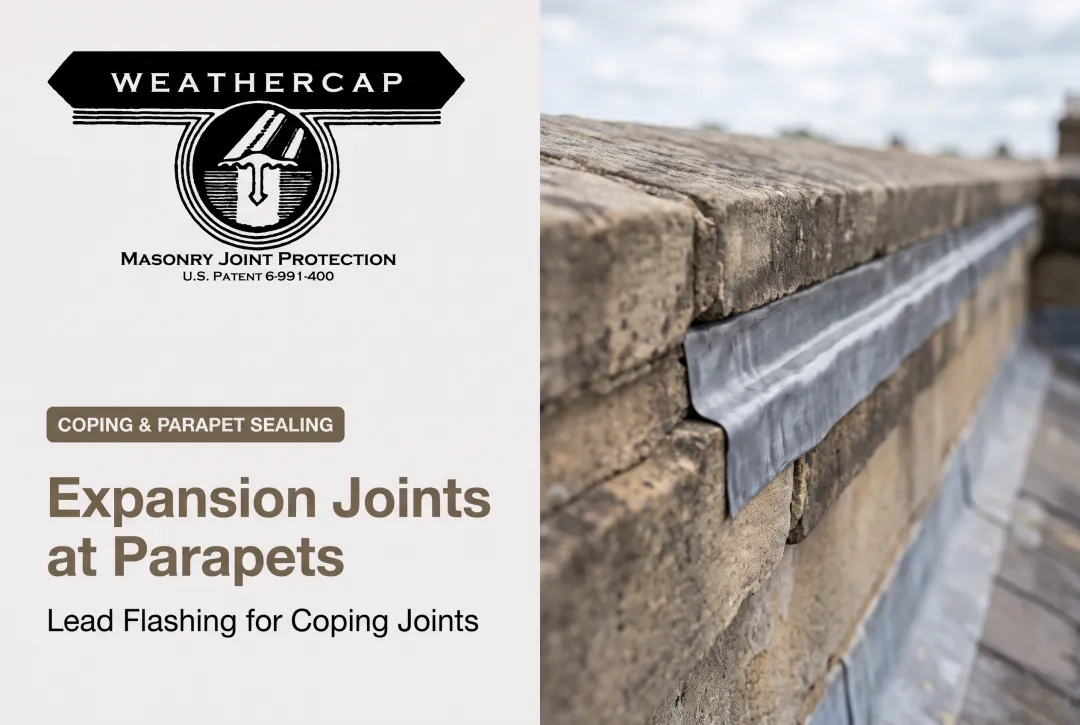
A soft lead strip inside the joint works differently than sealant alone. Instead of relying only on elasticity, it physically reduces how much the sealant must stretch.
Weathercap®'s patented lead strip system, made in Slidell, Louisiana, cuts the effective joint opening by roughly half when installed between sealant layers. The sealant then takes on far less movement. The system:
- Resists corrosion, mold, and mildew in humid climates
- Oxidizes to a neutral grey that blends with surrounding masonry
- Type A (flat cap) for coping top, side, and cross joints; Type B (90° cove cap) for cornices and right-angle joints
- Joint sizes from under 5/16 inch up to 1.5 inches I.D., depending on cap type
It is specified in the GSA's Historic Preservation Technical Procedures (Document 07656-01). Projects include the Washington Monument, the U.S. Supreme Court Building, the Smithsonian Institution, and the U.S. Treasury Building.

Material choice depends on climate and expected movement. High-UV regions favor silicone or lead-protected joints over exposed polyurethane. Buildings with settlement or heavy thermal cycling benefit most from a lead strip system, because it addresses movement directly rather than only resisting weather.
Best Practices for Waterproofing Coping Stone Installation
Joint material only performs if the installation details are right too.
- Install through-wall metal flashing beneath coping stones. This gives a redundant barrier in case the dowel penetration above ever leaks. CMHA guidance calls for a full mortar bed under this flashing so coping units sit correctly.
- Slope the coping and provide drip edges. Water needs somewhere to go besides straight down the wall face. Coping should extend at least 4 inches over the masonry face with drip control on both sides.
- Get joint width and depth right. For joints between ¼ and ½ inch, depth should be no greater than width. Oversized or undersized joints put sealant or lead strip under improper compression and shorten service life.
- Seal every dowel penetration carefully. Each anchor shaft is an individual weak point. Cut the joint to the anchor-shaft length plus ¼ inch, seat backer rod ¼ inch below the anchor tip, and keep at least ¼ inch of sealant between the shaft tip and the backer rod.

For lead strip installations specifically:
- Size the cap for joint opening, anticipated maximum movement, and an extra ¼ inch allowance
- Plan full-length runs with 6-foot material where possible
- Miter or cope ends where sections meet
Maintenance and Inspection Tips for Existing Parapet Coping
Coping joints don't fail overnight. They degrade gradually, which means routine inspection catches problems before they become interior damage.
What to look for:
- Cracking or gaps in existing sealant, especially after freeze-thaw seasons
- Interior staining near the top floor or roofline
- Efflorescence (white, powdery mineral deposits) on exterior masonry
- Moss or algae growth near parapet walls, indicating trapped moisture

Brick industry guidance points to sealant joint replacement, repointing, weep repair, and flashing replacement as standard parts of a masonry maintenance program.
If joints show early wear but haven't fully failed, you don't necessarily need a full tear-out. Adding a lead strip protection system during re-caulking can extend the life of the existing sealant instead of rebuilding the joint from scratch.
Typical process:
- Rake out the old joint and clean it thoroughly
- Size the cap to the joint opening plus movement allowance
- Install backer rod
- Press the lead strip firmly into a fresh sealant bed
Frequently Asked Questions
What is the best sealant for coping stones?
There's no single "best" option. Polyurethane offers affordability; silicone offers strong UV resistance. For restoration work that must handle ongoing building movement, a lead strip joint protection system used with the sealant is often preferred for long-term, low-maintenance performance.
Should you seal coping stones?
Yes. Sky-facing coping joints are directly exposed to rain and are the primary entry point for water if left unsealed, regardless of how well the stone itself is installed.
How often should parapet coping joints be inspected?
Annual inspection is a reasonable baseline, with additional checks after major storms in harsher climates. Freeze-thaw seasons in particular tend to reveal new cracking.
Can existing failed coping joints be repaired without full replacement?
Often, yes. A joint protection insert can be added during re-caulking to restore a watertight seal without removing and replacing the coping stones themselves.
Why do coping joints fail even when sealant is properly installed?
Ongoing building movement (thermal expansion, settlement, freeze-thaw cycling) eventually stresses sealant beyond its designed stretch capacity, even when installation was done correctly.
Are lead-based joint protection systems safe to use in restoration projects?
Yes, with proper handling: gloves, hand washing, and dust/fume controls per OSHA 29 CFR 1910.1025. GSA's Historic Preservation Technical Procedures specify lead strip flashing for federal restoration work when handled correctly.