
Unmanaged movement causes cracking, water infiltration, and repair bills that dwarf the cost of doing it right the first time. Here's the uncomfortable truth: most masonry "failures" aren't workmanship problems. They're design failures, caused by movement joints that were poorly placed, undersized, or left out of the drawings entirely.
This guide covers joint types, placement rules, spacing formulas, and how to protect the joints you've already installed so they actually last.
Key Takeaways
- Clay brick expands permanently; CMU shrinks as it cures—plan opposite joint strategies
- Expansion joints and control joints are not interchangeable: the wrong type causes failure
- Spacing at corners, openings, and material changes follows formulas, not guesswork
- Protecting sealant inside a movement joint extends the life of the full wall system
What Is a Brick Movement Joint and Why It Matters
A movement joint is an intentional, engineered gap built into a masonry wall to absorb dimensional change. Without it, the wall has only one way to release stress: cracking.
Clay brick and CMU move in opposite directions.
Fired clay brick permanently expands as it reabsorbs atmospheric moisture over its service life. That's why brick masonry primarily needs expansion joints — gaps that give the growing material room to grow.
CMU behaves the opposite way. Concrete masonry shrinks as it cures and dries, so CMU walls need control joints, which direct that shrinkage to a predictable, sealed location instead of letting it crack randomly across the wall face.

Expansion Joint vs. Movement Joint: What's the Difference?
"Movement joint" is the umbrella term. The Concrete Masonry & Hardscapes Association defines it as a generic joint that may serve one or more movement-related functions. Expansion joints, control joints, and isolation joints are all types of movement joints, each solving a different problem. Calling every joint an "expansion joint" is a common but inaccurate shorthand.
Whose Job Is It to Locate the Joints?
This is where most failures actually start. Per masonry code TMS 602 and TMS 402, locating movement joints is the building designer's responsibility, not the mason's. The code requires the designer to indicate joint type and location directly on the project drawings. When that detailing is missing or generic, masons are left guessing in the field, and guessing is how cracks happen.
Types of Masonry Joints You Need to Know
Masonry movement is handled with a few distinct joint types. Expansion and control joints manage volume change in the wall itself. Isolation and cold joints handle transitions between different conditions or materials.
Expansion Joints (Clay Brick)
Expansion joints are continuous gaps, typically sized to resemble a standard mortar joint, filled with a compressible material and sealed. The Brick Industry Association recommends a joint width around ½ inch, with 25–50% compressibility typical for the filler and sealant combination.
The joint must stay open across the full run of the wall to actually accommodate the brick's expansion.
Control Joints (CMU)
A control joint is a vertical plane of weakness, made by replacing a mortar joint with backer rod and sealant. It doesn't stop shrinkage. It directs that shrinkage to a location you choose, instead of letting it crack a window corner or a random course of block.
Reinforcement must be discontinued or debonded at the joint. Otherwise it restrains the very movement the joint is supposed to allow.
Isolation and Cold Joints
Isolation joints separate wall sections that have different heights, loads, or bearing conditions, preventing one section from transferring stress into another. They're a different tool entirely—not a substitute for regularly spaced expansion or control joints.
Cold joints (sometimes called sanded joints) typically occur where dissimilar materials meet. They aren't a formal code term. Treat them as project-specific details, not a standardized joint type.

How Often and Where to Place Movement Joints
The Brick Spacing Formula
BIA Technical Note 18A gives a defined formula for maximum theoretical expansion joint spacing:
Se = (wj × ej) / 0.09
Where wj is joint width and ej is percent compressibility of the sealant/filler system.
Worked example: With a ½-inch joint (wj) and 50% compressibility (ej):
Se = (0.5 × 50) / 0.09 = 278 inches, or roughly 23 feet 2 inches
That figure is a theoretical maximum for a straight wall with no openings. Treat it as a starting calculation: corners, doors, and windows will shrink the spacing.
General Spacing Guidelines
- Brick veneer: roughly 20-25 ft, depending on whether openings are present (openings tighten the spacing)
- CMU control joints: typically 20-25 ft, paired with horizontal joint reinforcement per CMHA's empirical tables
Corner Placement Rules
BIA guidance sets three corner checks:
- Place the first joint within about 2 feet of an outside corner on either side
- Keep an expansion joint within roughly 10 feet of at least one side of the corner
- Combined distance from the corner to the first joints on each wall should not exceed standard straight-wall spacing

Other Required Locations
Movement joints belong at:
- Inside and outside corners
- Changes in wall height or thickness
- Transitions between backing materials (steel stud to CMU, for example)
- Window and door openings — often aligning the joint with the opening edge
- Transitions between brick and other cladding materials
Joint Depth
Placement only works if the joint fully separates the masonry. Contraction and control joints should run the full depth of the veneer wythe for brick, or the full face-shell depth for CMU.
A shallow joint that doesn't penetrate the full wythe won't break the bond. The wall will still crack — just somewhere else.
Common Design and Installation Failures
Most movement joint failures trace back to a short list of repeatable mistakes:
- Relying on generic spec language instead of drawn, dimensioned joint locations
- Placing control joints at lintel ends rather than away from stress concentrations
- Ignoring corner spacing rules, leaving corners unprotected
- Using the wrong joint type for the material — an expansion joint where a control joint belongs, or vice versa
There's no single, industry-wide percentage that reliably attributes masonry cracking to movement-joint errors specifically — treat any such number with skepticism. What is documented: on one large hospital project, approximately 80% of CMU units in an accent band cracked due to differential movement, a project-specific consequence of inadequate joint detailing, not a national average.
Another frequent CMU failure is treating control joints and horizontal reinforcement as an either-or choice. Horizontal movement control needs both: proper control joint spacing plus horizontal joint reinforcement that carries tension across the panel between joints. Neither one alone does the job.
Protecting the Joint: Why Sealant Alone Isn't Enough
Here's the part designers often overlook. Even a perfectly placed, correctly sized movement joint can still fail — because the sealant inside it is doing all the work.
Caulk and sealant sitting in a movement joint face constant flexing, UV exposure, and moisture cycling. Even premium sealants degrade under that kind of repeated stress. A joint can be engineered exactly to code and still leak in ten years if the sealant is the only line of defense.
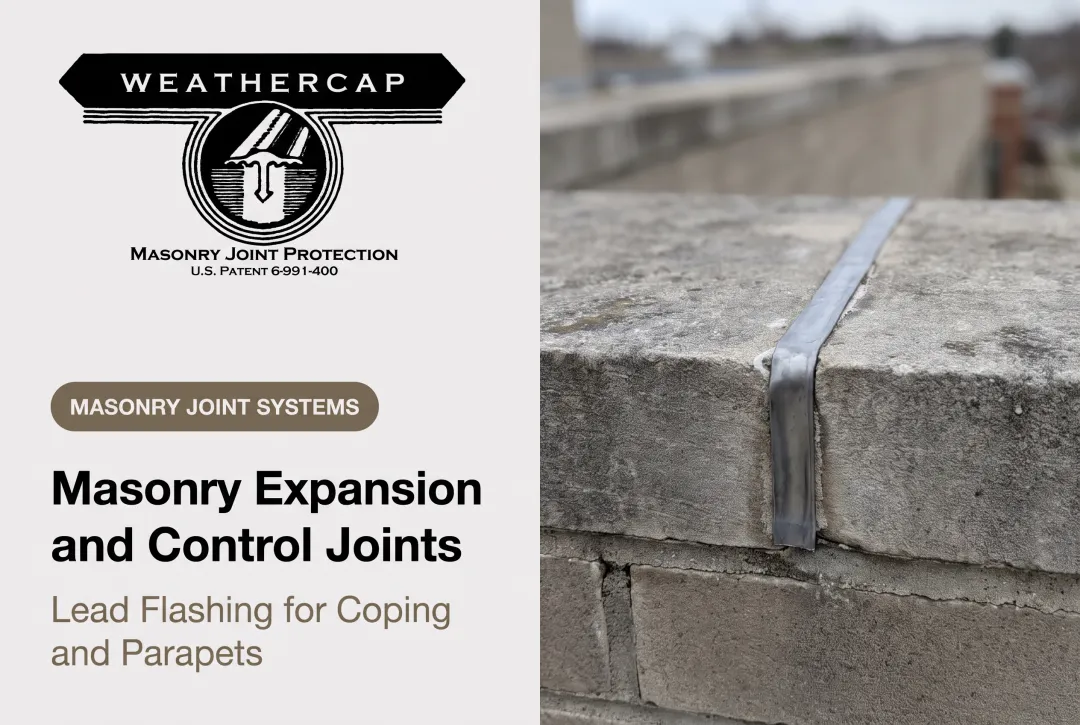
Weathercap® addresses this directly. It's a patented soft lead strip system, interposed within the sealed joint itself. Rather than replacing the sealant, it works alongside it:
- Reduces the effective joint opening that sealant has to bridge by roughly half
- Absorbs ongoing building movement through its low elastic modulus and creep behavior
- Resists corrosion, mold, and mildew in humid, exposed conditions
- Oxidizes to a neutral grey that blends into surrounding masonry rather than standing out
- Won't tear or shear under continued flexing, unlike a stretched sealant bead

Sizing follows a straightforward field method:
- Measure the joint opening
- Add the maximum movement percentage from a scribe test
- Add ¼ inch
That total sets the outer dimension of the cap.
Weathercap has been specified for joint protection on the Washington Monument, the U.S. Supreme Court, the Smithsonian Institution, and the U.S. Treasury Building, among other federal and historic structures. It's also referenced in GSA Historic Preservation Technical Procedures as lead stone flashing for weatherproofing masonry joints.
That kind of longevity requirement—restoration work where a callback isn't an option—is exactly the environment this protection was built for.
For architects specifying restoration work or new construction with long service-life expectations, that combination of movement accommodation and sealant protection matters more than the joint spacing calculation alone.
Frequently Asked Questions
How often do you need movement joints in brickwork?
Roughly every 20-25 feet for brick veneer, tightening toward 20 feet where multiple openings are present. BIA's spacing formula gives a theoretical maximum near 23 feet for a common ½-inch, 50% compressible joint.
Where should movement joints be located in masonry walls?
At outside and inside corners, near window and door openings, at changes in wall height or backing material, and anywhere brick transitions to another cladding type. Corners typically need a joint within about 2 feet.
What is the difference between an expansion joint and a movement joint?
"Movement joint" is the umbrella term. Expansion joints and control joints are specific types under that umbrella: expansion joints for clay brick and control joints for CMU shrinkage.
How do you control horizontal movement in a masonry wall?
Through properly spaced movement joints and horizontal joint reinforcement. Reinforcement carries tension across wall panels; joints release it at predictable points.
How close can a movement joint be to a corner?
Generally within about 2 feet of an outside corner, with a broader rule that a joint sits within roughly 10 feet of at least one side of that corner.
What are the different types of joints used in masonry?
Expansion joints (clay brick expansion), control joints (CMU shrinkage), and isolation joints (separating sections with different heights, loads, or bearing conditions).