
A widely cited English field study, referenced in a 2005 NIST paper on sealant service life, predicted that 55% of installed building sealant joints fail within 10 years, and 95% fail within 20 years. Once a joint opens up even slightly, water finds its way in, and repair costs climb fast.
Lead T-caps offer a different approach. Rather than replacing sealant, this patented protective system works alongside it, absorbing structural movement so the sealant underneath doesn't bear the full brunt of it. This guide covers what lead T-caps are, how they function, their real benefits, where they're used, and what to look for in a manufacturer.
Key Takeaways
- Soft lead T-caps absorb building movement in masonry joints and shield sealant from premature failure.
- Use Type A (Flat Cap) for standard joints and Type B (90° Cove Cap) for corners and parapet copings.
- Resist moisture, mold, and corrosion while gaining paintability and longer sealant life.
- Rely on U.S. Patent 6991400 tech proven on landmarks like the Washington Monument and U.S. Supreme Court.
What Are Lead T-Caps for Joints?
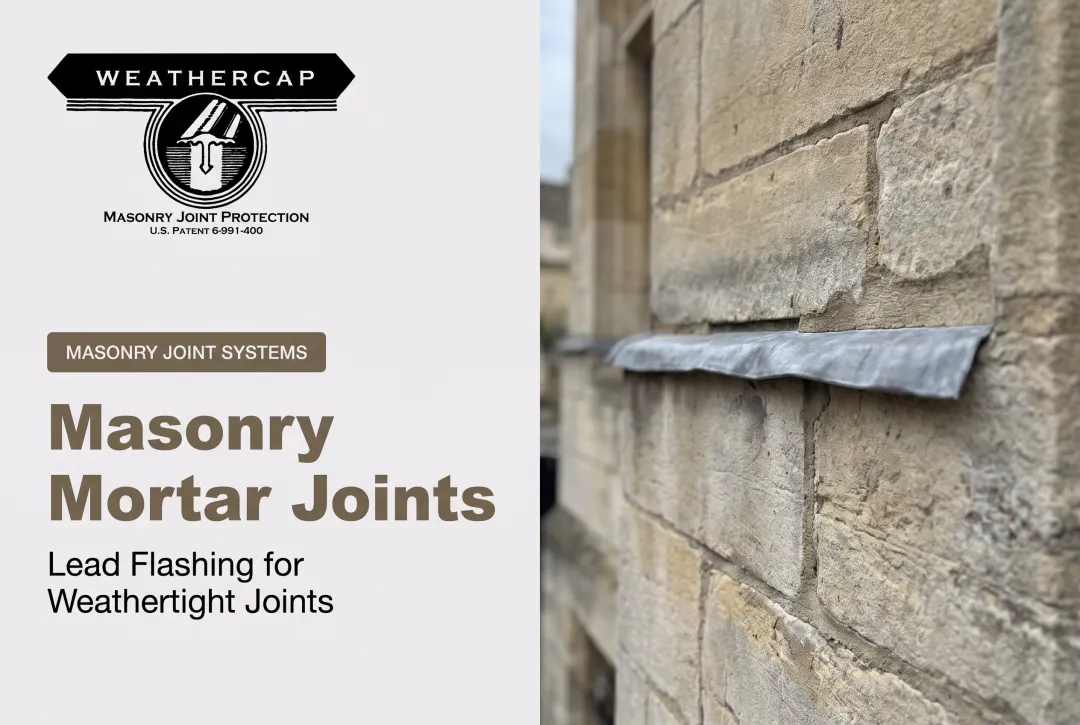
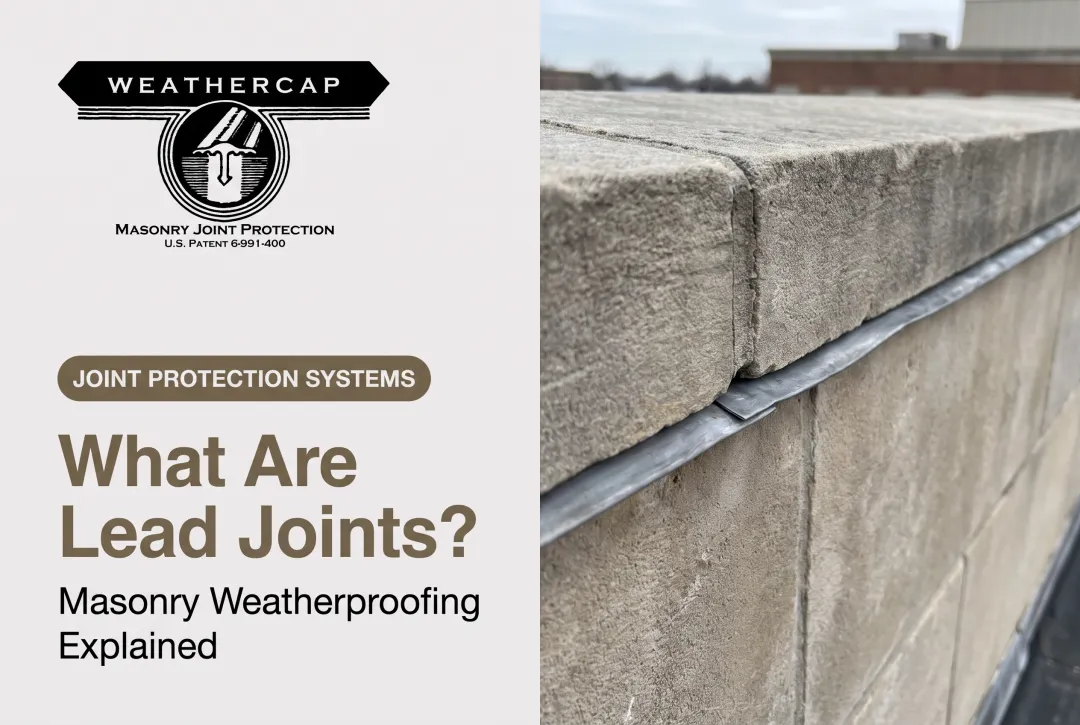
A lead T-cap is a patented joint protective system: a strip of soft lead formed with a cap portion and an anchoring shaft. It sits inside a masonry joint between two beads of sealant.
Installers apply an initial bead, embed the cap, then apply a second bead over the top to lock it in place.
The material science behind it is straightforward. Lead has low tensile strength, low hardness, low elastic modulus, and low creep strength. That sounds like a weakness, but it's actually the point.
- Low creep strength lets the lead gradually deform, or "creep," into a building's new joint configuration after movement, rather than resisting and cracking.
- Low elastic modulus means the material needs very little stress to deform, so it keeps absorbing movement within the joint's design limits.
- Temperature-responsive creep speeds up in heat and cold swings, so the cap keeps adjusting passively as the building expands and contracts with the seasons.

When interposed between sealant beads, a lead T-cap reduces the effective size of the masonry joint opening by roughly half, according to Weathercap's product documentation. That reduction matters because smaller effective openings mean less sealant is exposed to direct weathering and mechanical stress.
This isn't generic lead flashing repurposed for a new job. The design is protected under U.S. Patent 6,991,400, "Cap sealer for caulked joints," issued in January 2006. The patent describes a flexible cap with underside ridges and channels that bond into the sealant, plus an anchoring leg set into the sealant itself. That engineered detail is not something you get from off-the-shelf lead sheet.
Types of Lead T-Caps: Flat Cap vs. Cove Cap
Lead T-caps come in two configurations, each suited to a different joint geometry.
| Configuration | Best Used For | Typical Sizes |
|---|---|---|
| Type A (Flat Cap) | Standard horizontal and vertical masonry joints | A-2 through A-8 (joints from under 3/8" to 1.5") |
| Type B (90° Cove Cap) | Right-angle wall junctions, parapet copings | B-2 through B-8 (joints from under 5/16" to 1.25") |
Type A caps run in a straight profile, ideal where a wall face needs a clean, flat line of protection.
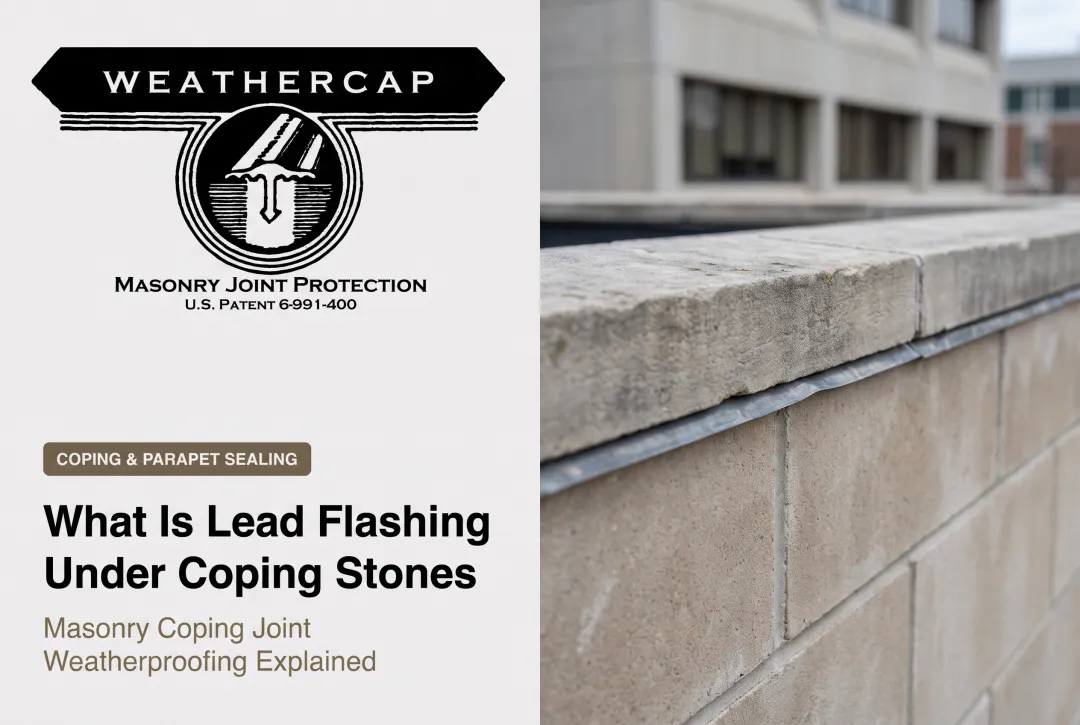
Type B caps use a cove shape that buffers stress where two planes meet—at corners and atop parapet copings—where movement concentrates and joint failures often start first.
How Lead T-Caps Protect Masonry Joints From Failure
Every building moves. Thermal cycling, wind load, foundation settlement, and material shrinkage all place ongoing stress on the mortar and sealant joints holding a facade together. Rigid caulk simply isn't built to absorb decades of that movement without cracking or pulling away from the substrate.
The lead cap sits within the joint itself, flexing as the building shifts. Because the cap absorbs and redistributes that movement, the sealant beads on either side experience far less direct mechanical stress. Instead of the sealant alone stretching, compressing, and eventually tearing, the lead does most of the work.
There's also a visual benefit that shows up fast. Lead's surface oxidizes rapidly, forming a dead neutral gray patina that blends naturally with most stone, brick, and mortar colors. That means many installations don't need immediate painting to look finished.
Other job-site properties matter too:
- Work as an adjunct, not a replacement—covering and protecting the sealant bead rather than substituting for it
- Buffer heat and cold at the joint line, since lead conducts thermal energy poorly compared with many building materials
- Reduce the effective joint opening when placed between sealant beads, so less sealant sits exposed to weather and UV
Key Benefits of Lead T-Caps
Beyond the core mechanics, lead T-caps deliver several practical advantages for anyone specifying or installing masonry joint protection.
- Blocks moisture penetration by covering the joint and shrinking the effective opening when sealant gaps under movement
- Extends sealant life by shielding it from UV exposure, weathering, and mechanical stress—factors NIST flags in sealant weathering—so joints need fewer replacement cycles
- Resists corrosion, mold, and mildew, especially in coastal or high-humidity climates where failed joints trap moisture
- Accepts paint to match the facade without hurting performance; many jobs skip paint and rely on the natural grey patina
- Conforms to repeated movement without tearing or shearing, thanks to low creep strength, unlike brittle sealant that eventually cracks

Exact ROI percentages for fewer reseals are not standardized industry-wide, and hard-number claims deserve skepticism. What is well documented is the cost stack of each resealing cycle:
- Substrate cleaning and adhesion testing
- Crew mobilization
- Facade access equipment or fall protection staging
Cut how often that full process repeats, and the avoided costs add up on their own.
Applications and Installation of Lead T-Caps
Lead T-caps show up wherever masonry joints face persistent movement and moisture exposure.
Common applications include:
- Horizontal and vertical masonry joints on facades
- Copings atop parapets, where wind and thermal exposure are highest
- Right-angle wall junctions and corner details
- Historic restoration, where original stonework must stay intact while leaks stop
Installation uses a sandwich method:
- Apply an initial bead of sealant into the prepared joint, filling it solidly to a slight excess above the masonry surface.
- Press the cap firmly into place so the bonding grooves on its underside fill completely with sealant, leaving no voids.
- Apply a second bead over the top, locking the cap between two layers.
Practical notes for anyone new to the material:
- Caps ship in 6-foot lengths and get cut on-site to match specific joint dimensions.
- Place backer rod roughly 1/4" below where the cap's anchor shaft tip will land, so sealant fully surrounds the shaft.
- Avoid puncturing the strip. Lead is soft, so firm, even pressure works better than force or sharp-edged tools.
- Keep the anchor shaft fully embedded in sealant—never against mortar, masonry, or the backer rod itself.
Choosing a Trusted Lead T-Cap Manufacturer
Not every lead strip marketed for masonry joints is engineered the same way. A few things separate a proven system from generic material.
- Patented design (U.S. Patent 6,991,400) reflects real engineering in the geometry, not a sheet of lead cut to size
- Field-proven on 28+ nationally significant landmarks, including the Washington Monument, U.S. Supreme Court, Smithsonian Institution, and U.S. Treasury Building
- Referenced in GSA Historic Preservation Technical Procedures for lead stone flashing, confirming vetting for federal restoration work
- Ships standard orders within 48 hours from its Slidell, Louisiana facility when restoration schedules leave little slack

If a supplier can't point to documented, high-profile project history or clear technical specifications, pause before committing material to a restoration timeline.
Frequently Asked Questions
What is a lead T-cap used for in masonry?
A lead T-cap is a flexible protective strip placed in masonry joints between two beads of sealant. It absorbs building movement and shields the sealant from failure and moisture intrusion.
How long do lead T-caps last compared to caulk alone?
Protected joints typically outlast sealant installed alone. Lead resists tearing and conforms to movement, which extends the joint system’s overall service life.
Can lead T-caps be painted to match a building's facade?
Yes. They accept paint without losing performance, though the lead surface also oxidizes naturally into a neutral grey that blends with most masonry colors on its own.
What's the difference between Type A and Type B lead T-caps?
Type A (Flat Cap) suits standard horizontal and vertical joints with a straight profile. Type B (90° Cove Cap) is built for corner junctions and parapet copings, where its cove shape buffers concentrated stress.
Are lead T-caps safe to use given lead exposure concerns?
Once installed, the cap sits fully encapsulated within sealant, not exposed to contact. Installers should still follow standard handling precautions, such as gloves and hand washing, per the manufacturer's safety data sheet.
Where can I purchase lead T-caps for a restoration project?
Weathercap® ships Type A and Type B lead T-caps directly to contractors and distributors across the U.S., typically within 48 hours of order placement.