
Many homeowners and contractors spend hours picking the perfect stone. Fewer stop to think about how joint style, mortar type, and long-term protection affect durability. That's a mistake, because joints are usually where failure starts.
This guide covers mortar types, common joint and grout styles, why joints fail, and how to protect them for the long haul.
Key Takeaways
- Type N mortar is standard for stone veneer thanks to its flexibility and lower compressive strength.
- Joint style (flush, raked, overgrout, dry-stack) changes appearance and weather resistance.
- Stiff mortar cracks under building movement, temperature swings, or settlement.
- Soft lead strip systems extend sealant joint life at high-stress points.
What Type of Mortar Should I Use for Stone Walls?
Mortar for unit masonry falls under ASTM C270, which defines four types: M, S, N, and O, using either a proportion or property specification method ASTM C270. Each type behaves differently once it's in the wall.
According to the Mason Contractors Association of America, minimum compressive strengths run 2,500 psi for Type M, 1,800 psi for Type S, and 750 psi for Type N Mason Contractors Association of America. A typical Type N mix uses roughly 1 part portland cement, 1 part lime, and 6 parts sand.
Why Type N Wins for Stone Veneer
Type N's lower cement content makes it more flexible than Type M or S. That flexibility matters because stone is rigid. When a wall shifts even slightly, a stiff mortar has nowhere to go except crack.
The Indiana Limestone Institute puts it directly: set the stone with Type N mortar, and don't go stronger for pointing or repointing work. Their reasoning is compatibility—a hard pointing mix places excessive stress on stone edges during building movement, leading to chipping or spalling at the edges.
Practical rule: mortar strength should be equal to or lower than the stone it's bonding, not higher. Type M may look like the strongest option on paper, but higher strength often works against the stone rather than with it.

Once the mortar type is set, color becomes the next decision that shapes how the finished wall reads.
Mortar Color Matters More Than You'd Think
Contrasting mortar highlights every joint line and any irregularities in stone placement. Matching mortar blends joints into the stone, hiding minor imperfections and creating a more uniform, monolithic look.
Before committing to a full wall:
- Build a small mock-up panel
- Test your chosen mortar type against the actual stone
- Check color in both wet and cured states
- View the panel in daylight and shade
A mock-up catches color and joint issues before they scale across the full facade.
Does Mortar Bond to Stone? Understanding Mortared Stone
Yes. Mortar bonds to stone through a mechanical key, not a chemical reaction.
"Mortared stone" means veneer set in a wet mortar bed with mortar-filled joints, unlike dry-stack installation, which uses little or no mortar between units. Moisture-retaining ingredients in the mortar (lime or cellulose ether) keep the paste workable long enough to be drawn into the pores and texture of the stone or scratch coat surface Mason Contractors Association. That mechanical key is what holds the assembly together.
Factors that weaken the bond:
- Inadequate surface preparation on the scratch coat
- Material incompatibility between mortar and stone
- Bond-breakers like dust, oil, or old coatings
- Poor weather conditions during application
- Rushed or improper application technique
Dense, smooth stone poses a particular challenge. Without a properly scored scratch coat or added bonding agents, mortar has nothing to grip. For adhered veneer, polymer-modified mortars and liquid bonding agents improve adhesion on lightweight manufactured stone and thin-cut natural stone.
Common Types of Joints Used in Stone Masonry
Joint style changes both the look of a wall and how it handles water. These are the main options.
Flush joints bring mortar level with the stone face, creating a smooth, contemporary, almost monolithic surface. Popular in modern architecture.
Raked/standard joints recess the mortar slightly, usually creating shadow lines that add depth and dimension. This is the most widely used style across residential and commercial stone veneer.
Overgrout/wide joints spread mortar beyond the stone edges intentionally, producing an old-world, rustic look. Common in historic restoration that matches the original construction.
Dry-stack/open joints use minimal to no mortar at all. The look is rugged and natural, but performance depends heavily on climate. Without mortar sealing the gaps, water intrusion becomes a real concern in wet regions.

Specialty joints include:
- German Schmear: mortar smeared across the stone face for a weathered, whitewashed effect
- Trowel-struck: hand-tooled for texture
- Beaded/convex: rounded profile, decorative
These specialty styles suit interior walls or accent features more than harsh exterior exposure.
Regardless of style, workmanship matters. Brick Industry Association guidance on water penetration resistance advises that exterior mortar joints should be completely filled and tooled at thumbprint hardness. That consolidates the joint and seals it against moisture. A pretty joint that isn't properly packed will still leak.
Why Mortar Joints Fail—and How to Protect Them
Stone doesn't flex. Buildings do, constantly, through temperature swings, settlement, and load shifts. When that movement concentrates at a rigid mortar joint, something has to give.
Masonry magazine notes that stone panel joints must accommodate dimensional tolerances, provide a weathertight seal, and relieve stress from stone and backup movement all at once. Because stone itself is stiff, mortar-filled joints often crack prematurely when forced to absorb flexure they weren't designed for.
An industry rule of thumb: flexible joint protection becomes especially important once stone panels exceed roughly 16 inches square, since larger units concentrate more stress at their joints.
What Happens After a Joint Cracks
Once a mortar joint fails, water gets in. From there:
- Moisture penetrates behind the stone face
- Freeze-thaw cycles expand trapped water, causing spalling
- Efflorescence appears as salts leach to the surface
- Structural damage accumulates over repeated cycles
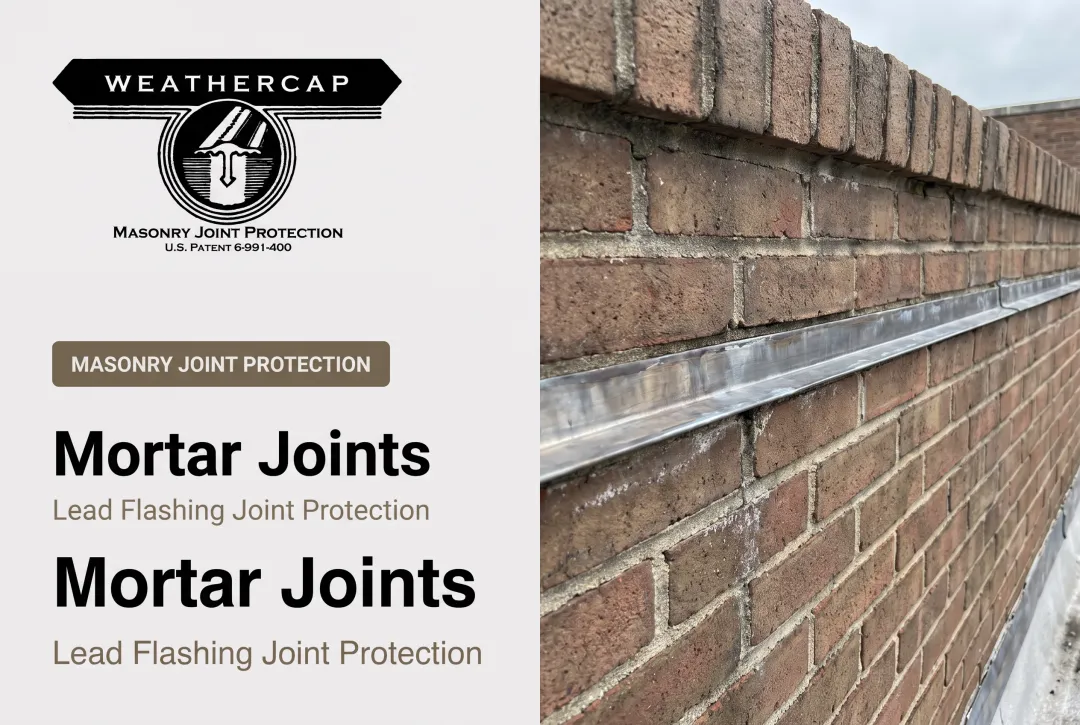
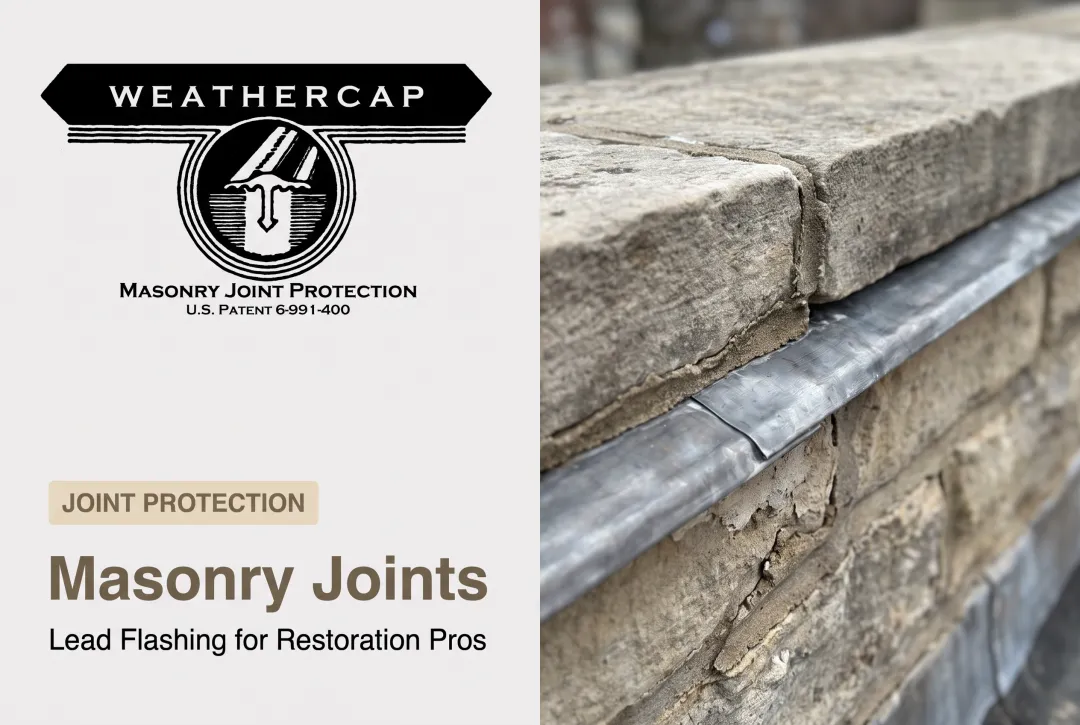
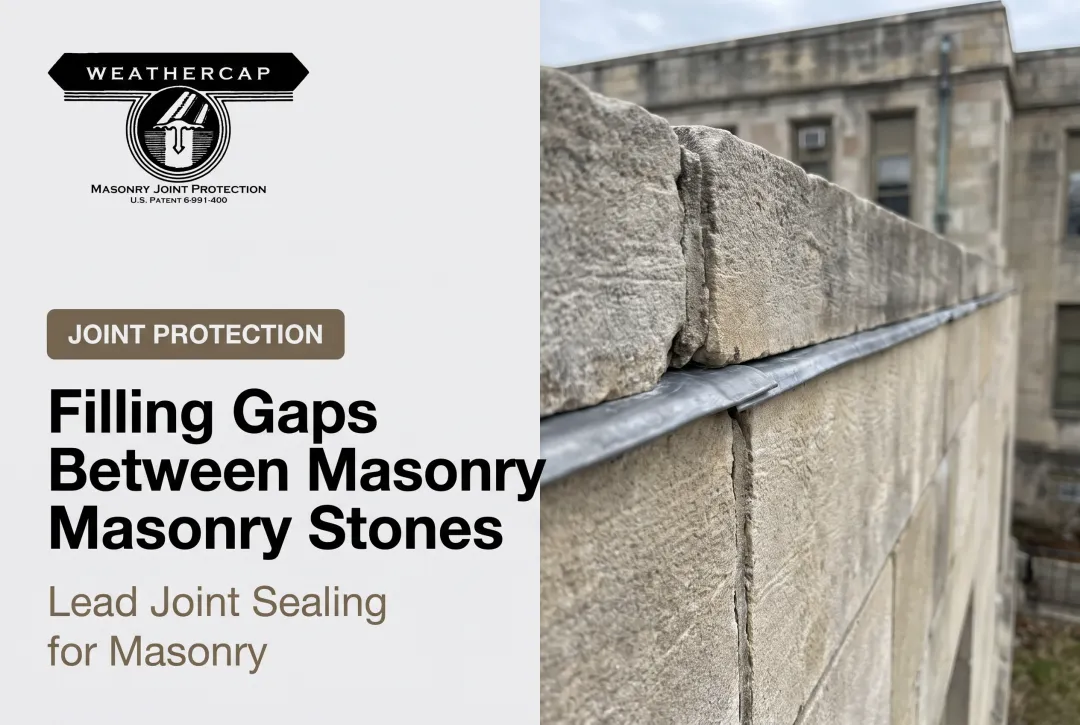
Weathercap's soft lead strip technology targets this failure mode directly. Interposed within sealed masonry joints, the system cuts the joint opening that must be sealed by half. Its low elastic modulus absorbs ongoing movement instead of transferring stress to the sealant GSA.

Architects have specified it on projects including the Washington Monument, U.S. Supreme Court, and Smithsonian Institution, among dozens of other federal and civic landmarks.
This kind of protection matters most at copings, parapets, and right-angle wall junctions, where stress naturally concentrates. Type A lead strip configurations are typically used at coping and balustrade joints, while Type B configurations suit 90-degree junctions where cornices, belt courses, or window lintels meet a parapet or side wall.
Best Practices for Long-Lasting Stone Veneer Joints
A few habits separate joints that last decades from joints that need repointing in year five. During construction:
- Rake back setting mortar and delay final pointing until the wall settles somewhat, which reduces cracking as loads shift
- Rinse joints clean of dust before pointing so they're damp, not soaked
- Damp-cure new mortar work for at least 72 hours where possible For wider joints and sealant selection:
- Use backer rod sized correctly for the joint width
- Choose non-staining, flexible sealants; urethanes handle substrate stress well, while silicone may last longer in some uses (SWR Institute)
- Avoid antifreeze agents or chlorides in cold-weather mortar work Ongoing maintenance:
- Inspect joints annually, especially in high-humidity or freeze-thaw climates
- Look for hairline cracking or separation before it becomes a leak
- Repoint hairline cracks early; the fix costs far less than remediating water damage behind the veneer For high-stress locations, specify supplemental protection like a lead strip system at the design stage rather than adding it after a leak appears. Weathercap ships its Type A and Type B products in 6-foot lengths, generally within 48 hours of order placement, which helps contractors plan material delivery around a restoration schedule.

Frequently Asked Questions
What type of mortar should I use for stone walls?
Type N mortar is recommended for stone veneer because its flexibility and lower compressive strength reduce stress on stone edges during building movement. Contrasting mortar colors highlight joints; matching colors blend them in.
Does mortar bond to stone?
Yes, mortar mechanically bonds to stone by keying into textured or porous surfaces as moisture-retaining ingredients draw paste into the pores. Bond strength depends heavily on surface preparation, moisture conditions, and stone density.
What are the common types of joints used in stone masonry?
The main styles are flush (level with the stone), raked (recessed for shadow lines), overgrout (mortar extending over stone edges), and dry-stack (minimal mortar). Specialty finishes like German Schmear or beaded joints suit interior or accent applications.
What is mortared stone?
Mortared stone is veneer installed with a wet mortar bed and mortar-filled joints, as opposed to dry-stack methods that use little to no mortar between units. It's the more common approach for weatherproof exterior applications.
How wide should a mortar joint be for stone veneer?
Joint width varies by project and stone profile, so always confirm with the manufacturer's specification. A mock-up panel is the best way to test width, color, and tooling technique before full installation.
How can I prevent my stone veneer mortar joints from cracking?
Use a flexible mortar suited to the stone, tool joints at thumbprint hardness, and inspect annually for early cracks. At high-stress points like copings and parapets, joint protection systems can absorb movement that mortar alone can't handle.