
Many building owners struggle with a hard reality, though. Historic masonry isn't just a design asset. It's a maintenance liability that faces relentless weathering, joint failure, and moisture intrusion.
This guide covers the preservation approaches available, the steps a real project takes, and the technical details, especially masonry joints, that determine whether a restoration lasts decades or fails within a few winters.
Key Takeaways
- Preservation work falls into four official treatments: preservation, rehabilitation, restoration, and reconstruction
- Success starts with proving significance and finding the building a sustainable purpose
- Funding almost always requires layering grants, tax credits, and private partnerships
- Masonry joint protection is the detail most projects overlook, and the one that causes the most callbacks
What Is Historic Preservation and Why Does It Matter?
Historic preservation means protecting buildings, objects, and places with historic, cultural, or architectural significance. The framework comes from the National Historic Preservation Act of 1966, which established a national preservation program. Section 106 requires federal agencies to weigh how their projects affect listed or eligible properties.
Preservation keeps history working in the present. Adaptive reuse is the usual path: a mill becomes apartments, a depot becomes a transit hub, a courthouse becomes a museum.
The Carbon Case for Reuse
Reusing an existing building avoids the upfront emissions tied to mining, manufacturing, and transporting new materials. A highly efficient replacement building can take 10 to 80 years to repay the carbon debt created by demolishing what's already standing, according to the National Trust for Historic Preservation.
Economic Payoff
Carbon savings are only part of the story. The economic returns are concrete:
- Private historic rehabilitation investment generated more than $12.8 billion in economic output and about 116,000 jobs in FY2024, per the National Park Service
- Since 1976, the federal tax-incentive program has leveraged $257.8 billion in private investment
- Preserved districts drive tourism and downtown revitalization in ways generic new construction rarely matches
The Four (Really Six) Approaches to Saving a Historic Building
The Secretary of the Interior recognizes four official treatments, though two additional strategies come up constantly in real-world projects.
- Preservation: Retains a building's existing form and materials with minimal alteration. Best for structures in good condition where the goal is stabilization, not change.
- Restoration: Returns a building to its appearance during one specific historic period, using documented evidence to remove or replace non-period features.
- Rehabilitation: Repairs and updates a building for continued or new use while retaining character-defining features. This is the most common approach for buildings that need to earn their keep.
- Reconstruction: Uses new construction to recreate a resource that no longer survives, built on its historic location.

Two other tools matter, even though they're not part of the official four:
- Mothballing: Temporary weatherproofing and security when funds aren't available yet for a full treatment. It's a holding pattern, not a permanent solution.
- Moving: Relocating a structure when its original site is no longer viable, used sparingly and only as a last resort.
Steps to Successfully Preserve a Historic Building
Every successful project follows a similar sequence, regardless of building type or budget.
- Establish significance. Document the building's historic, cultural, or architectural value and pursue National Register of Historic Places listing if eligible.
- Find a sustainable purpose. A building without a use plan rarely survives long-term, no matter how beautiful its facade.
- Build a coalition. Historical societies, local government, your State Historic Preservation Officer (SHPO), and experienced contractors all play a role.
- Secure layered funding. Most projects combine state grants, the federal 20% Historic Tax Credit for income-producing buildings, private donations, and fundraising.
- Plan for the long haul. Parts 1 and 2 of the federal tax-credit review generally take 60 days each, but total project timelines often run years. Preservation policy also varies significantly by state.

Saint Paul Union Depot's rehabilitation is a good illustration of this layering in action, with $243 million drawn from federal, state, and local sources before a single stone was cleaned.
Common Threats Facing Historic Masonry Buildings
Masonry doesn't fail overnight. It fails through accumulation.
- Deferred maintenance: Small problems compound. A cracked mortar joint left alone becomes a spalled brick, then a structural repair.
- Weather exposure: Freeze-thaw cycles, wind-driven rain, and humidity break down mortar and sealant joints year after year.
- Building movement: Settlement and thermal expansion can stress joints for decades—often invisibly—until a joint finally opens.
The GSA's Historic Preservation Technical Procedures treat even hairline cracking at a joint edge as unacceptable on federal buildings. The standard calls for correction, not cosmetic concealment.
Protecting Masonry Joints: A Critical but Overlooked Preservation Detail
Here's where a lot of otherwise well-executed preservation projects go wrong. Standard caulk and sealant, applied alone, cannot accommodate ongoing building movement.
As a structure settles or expands with temperature swings, the sealant stretches past its limits, cracks, and lets water in. That water then drives the freeze-thaw damage described above.
How a Soft Lead Strip Stops Joint Failure
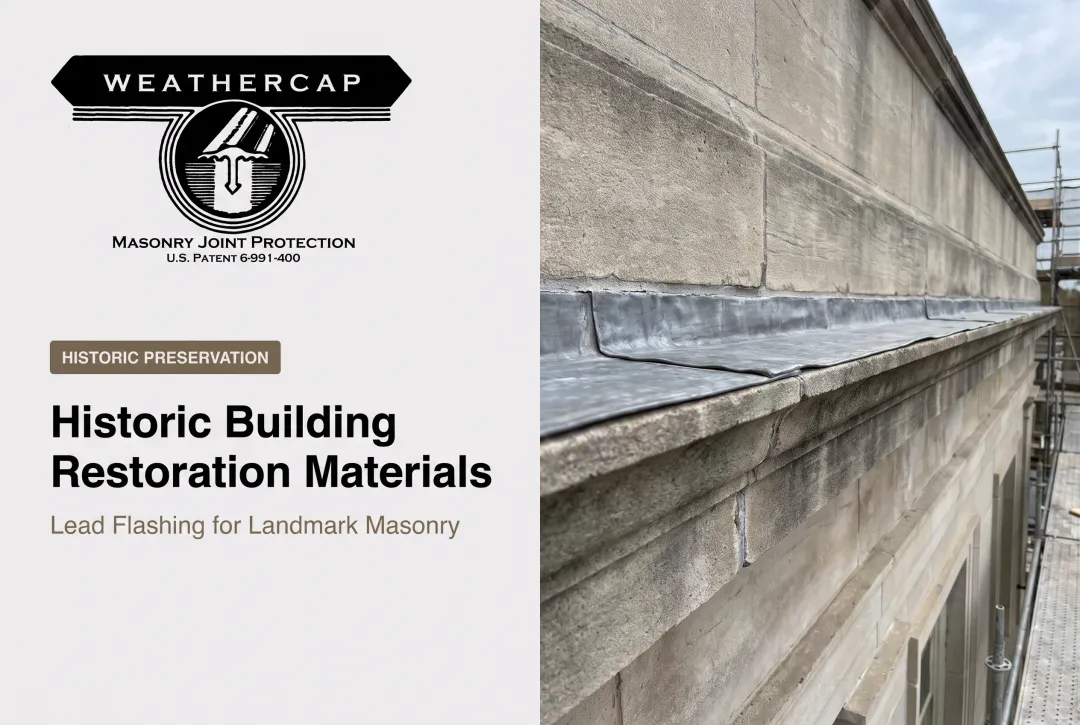
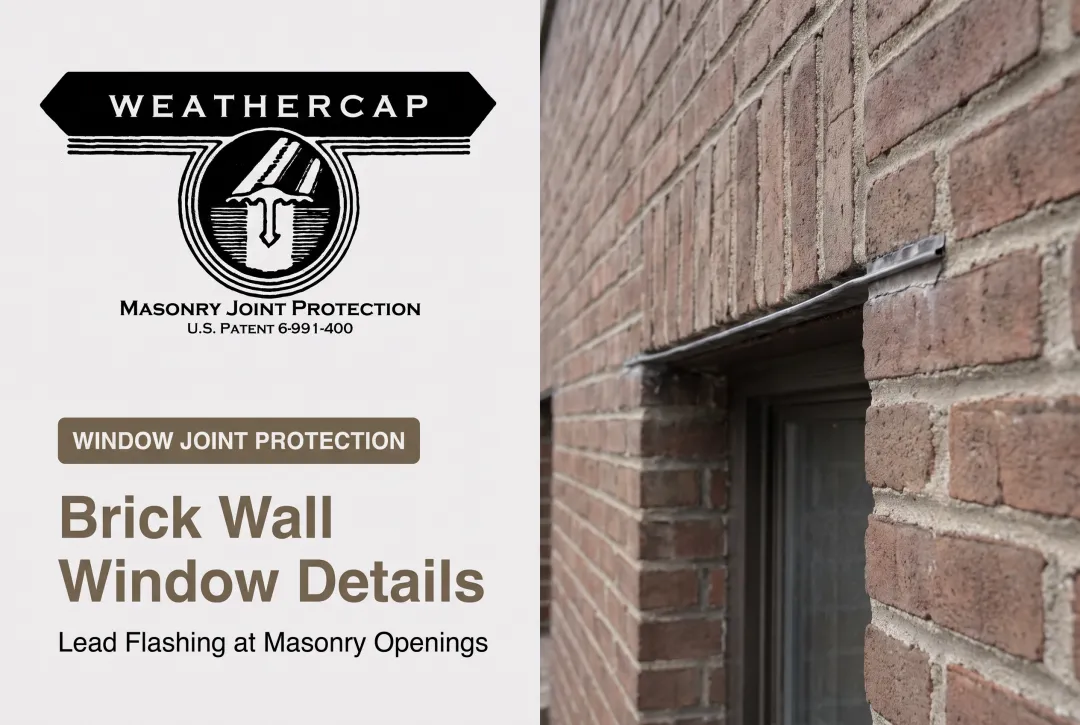
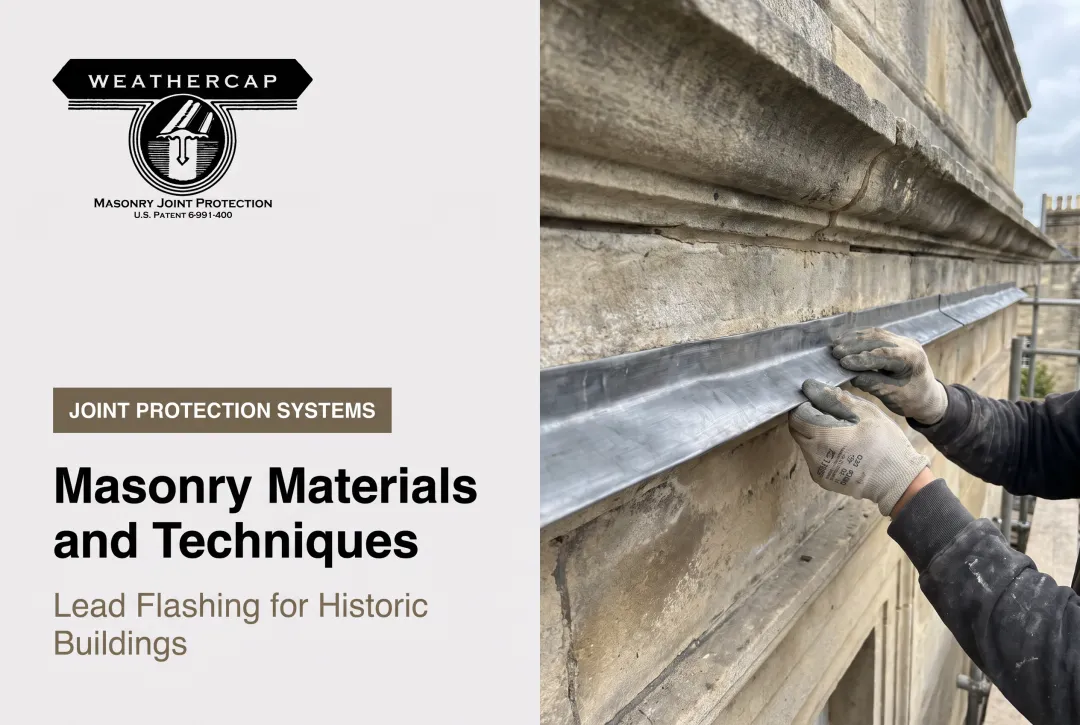
This is the specific problem WEATHERCAP® was developed to solve. It's a patented soft lead strip system, specified in GSA's Historic Preservation Technical Procedures (Document 07656-01), designed to buffer stress at copings, parapets, and joint transitions.
Under movement, the strip works in four ways:
- Deforms gradually (low elastic modulus and controlled creep) so it conforms to the joint instead of tearing
- Reduces the effective joint opening by half when set in the sealant, cutting the span and stress the sealant must carry
- Resists corrosion and mildew in high-humidity environments
- Oxidizes to a neutral grey that blends with surrounding masonry

Sizing matters. Installers measure the joint opening, add the maximum movement percentage from a scribe test, then add ¼ inch to get the correct outer dimension.
Proven on the Buildings That Can't Afford to Fail
This type of joint detailing has been used on the Washington Monument, U.S. Supreme Court, and Smithsonian Institution, along with the U.S. Treasury Building, Grand Central Station, and more than two dozen other nationally significant landmarks.
For contractors on tight restoration windows, logistics matter too. WEATHERCAP ships Type A (Flat Cap) and Type B (90° Cove Cap) in 6-foot lengths, within 48 hours of order placement.
Success Stories and Lessons from Real Preservation Projects
Saint Paul Union Depot is a clear case of layered funding and phased planning. The Ramsey County Regional Railroad Authority acquired the depot's concourse and headhouse in separate purchases, then built a $243 million stack from:
- Federal SAFETEA-LU dollars
- USDOT TIGER grants
- Federal Railroad Administration funds
- Local bonds
The project restored historic features and the plaza, added platforms and light-rail infrastructure, and reopened to Amtrak service in 2014.
Wayne Aspinall Federal Building, a GSA courthouse in Colorado, took a different route. A $15 million Recovery Act grant funded a modernization that restored the lobby, colonnade, and original woodwork while cutting energy-use intensity roughly in half, from 42.6 to 21 kBtu per square foot.

Lessons for smaller projects:
- Funding rarely comes from one source—plan for a stacked mix early
- Technical detailing (energy retrofits, joint protection, moisture control) is what keeps the historic fabric sound after the ribbon is cut
Frequently Asked Questions
What are the four types of historic preservation?
The four standard treatments are:
- Preservation — keeps existing materials and form as-is
- Rehabilitation — repairs and updates a building for continued use
- Restoration — returns it to one specific historic period
- Reconstruction — rebuilds elements that no longer survive
Is historic building preservation worth it?
Yes. Projects often pay off through the 20% federal tax credit, tourism revenue, and embodied carbon savings, though they still require significant time and funding upfront.
What is the difference between preservation and restoration?
Preservation keeps a building's existing materials and form largely untouched. Restoration goes further, removing later additions to recreate the building's appearance during one specific historic period.
How long does a historic building preservation project take?
Timelines commonly range from six months to several years, depending on funding sources, project scope, and regulatory review. Federal tax-credit reviews alone can take 60 days per application phase.
Can a historic building be modified while preserving its historic status?
Yes, with proper approval. Local preservation boards typically require a Certificate of Appropriateness before exterior changes, demolition, or new construction proceeds.
What causes the most damage to historic masonry buildings?
Weathering (especially freeze-thaw cycles), building movement from settlement, and joint or sealant failure cause most long-term masonry damage.