
But masonry isn't foolproof. Choose the wrong material or skip the right technique, and you're looking at moisture damage, cracking, and joint failure that can cost far more to fix than to prevent.
This guide walks through the common masonry materials, the construction techniques that determine strength and cost, and the joint protection systems that keep water out for good.
Key Takeaways
- Brick, stone, concrete block, glass block, and adobe each serve different structural and aesthetic purposes.
- Load-bearing, reinforced, veneer, and dry stack techniques carry distinct strength, cost, and code requirements.
- Moisture infiltration drives most long-term masonry failure—mortar quality and joint protection are the primary controls.
- Specialized joint systems extend service life on historic restoration projects where building movement defeats caulk alone.
What Is Masonry Material?
Masonry is the practice of building structures from individual units, such as brick, stone, or concrete block, bound together with mortar. The TMS 402-22 code, which governs masonry design nationwide, defines minimum requirements for masonry units bedded in mortar. The 2021 International Building Code requires all masonry construction to comply with TMS 402 or related standards.
Masonry construction isn't new. Romans were producing concrete more than 2,000 years ago, and structures like the Pantheon and Colosseum are still standing today. Gothic cathedrals pushed stone masonry to new structural limits centuries later. Modern masonry is governed by standardized codes rather than trial and error.
Is Masonry Different from Concrete?
This trips people up constantly. Concrete block (CMU) is a masonry material; poured concrete is not. Masonry means stacking individual units—brick, stone, or block—in mortar. Cast-in-place concrete is a different construction method, even though both show up on the same job sites.
Common Masonry Materials
Each material brings its own strengths to a project. Here's how they stack up:
- Brick — Fire-resistant and durable, with the Brick Industry Association reporting an average lifespan of 100 years for well-maintained brickwork. Common in facades, chimneys, and load-bearing walls.
- Stone — Used in ashlar (cut, fitted) and rubble (rough, uncut) forms for monuments, retaining walls, and historic landmarks.
- Concrete block (CMU) — Cost-effective and strong; the workhorse of foundations and commercial walls.
- Mortar and grout — The bonding agents that hold units together and distribute structural loads across the wall.
- Adobe — A traditional material requiring careful moisture-sensitive detailing, per National Park Service preservation guidance.
- Glass block — Decorative and light-transmitting, but the 2018 IBC prohibits its use in fire walls, load-bearing applications, and smoke barriers.
- Stone veneer — A budget-conscious alternative that mimics natural stone's look without the structural weight or cost.

The 100-year brick figure is an industry benchmark, not a guarantee. Installation quality, exposure, and mortar choice all affect real-world performance.
Key Masonry Construction Techniques
The technique you choose determines the wall's strength, cost, and code compliance.
Structural Systems
Load-bearing masonry supports the weight of roofs and floors directly through the wall itself. It's common in residential construction and governed under TMS 402's structural design provisions.
Reinforced masonry embeds steel within the wall to resist seismic and wind loads. You'll see it on commercial and high-rise projects where code demands extra lateral resistance.
Veneer masonry is non-structural under TMS 402. It's a thin decorative layer attached to a structural backing, so it needs separate detailing for anchorage, support, and drainage.

Dry Stack Masonry
Dry stack skips mortar altogether, relying on precise unit stacking for stability.
Code and installation requirements to watch:
- Follow TMS 402 as modified by 2021 IBC Sections 2114.2 through 2114.5
- Prohibited in Risk Category IV structures (hospitals, emergency facilities)
- Set the first course on a smooth, level bearing surface so the wall stays plumb (CMHA)
Bond Patterns
Bond patterns describe how units and joints line up across a wall face. Common options include:
- Running bond
- Header bond
- Flemish bond
- English bond
Beyond appearance, pattern choice affects how loads distribute through the assembly. The Brick Industry Association's Technical Notes cover these patterns in detail for anyone specifying a facade.
Protecting Masonry Joints from Moisture and Movement
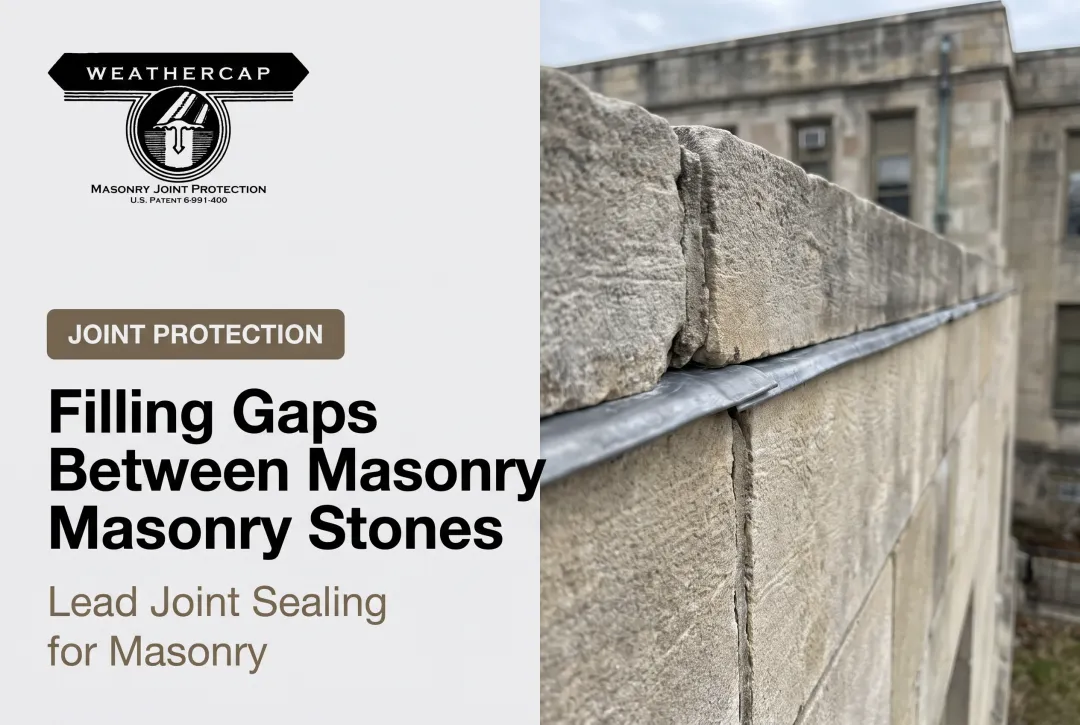
Here's where a lot of otherwise solid masonry work starts to fail. Caulk and sealant joints degrade over time, largely because buildings move and settle in ways nobody fully predicts. This is especially true at copings atop parapets and at right-angle wall junctions, where two planes meet and stress concentrates.
Unmanaged movement produces what's called "joint-checking." Once that starts, water finds its way in, and moisture infiltration remains one of the most persistent causes of long-term masonry deterioration.
How Soft Lead Strip Systems Help
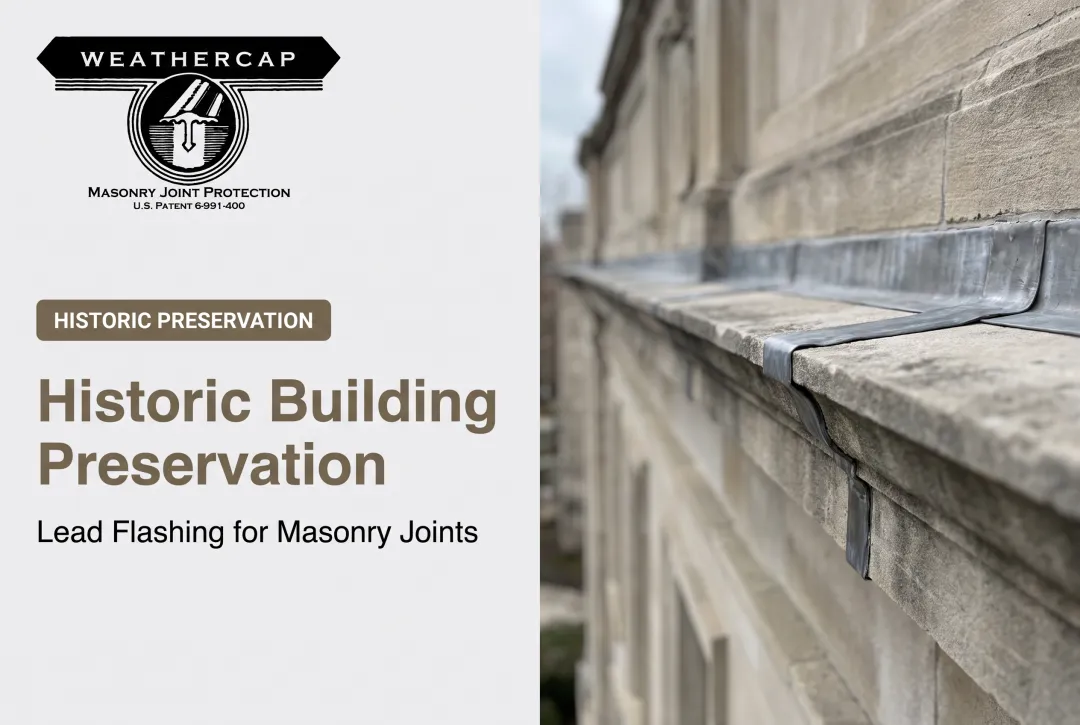
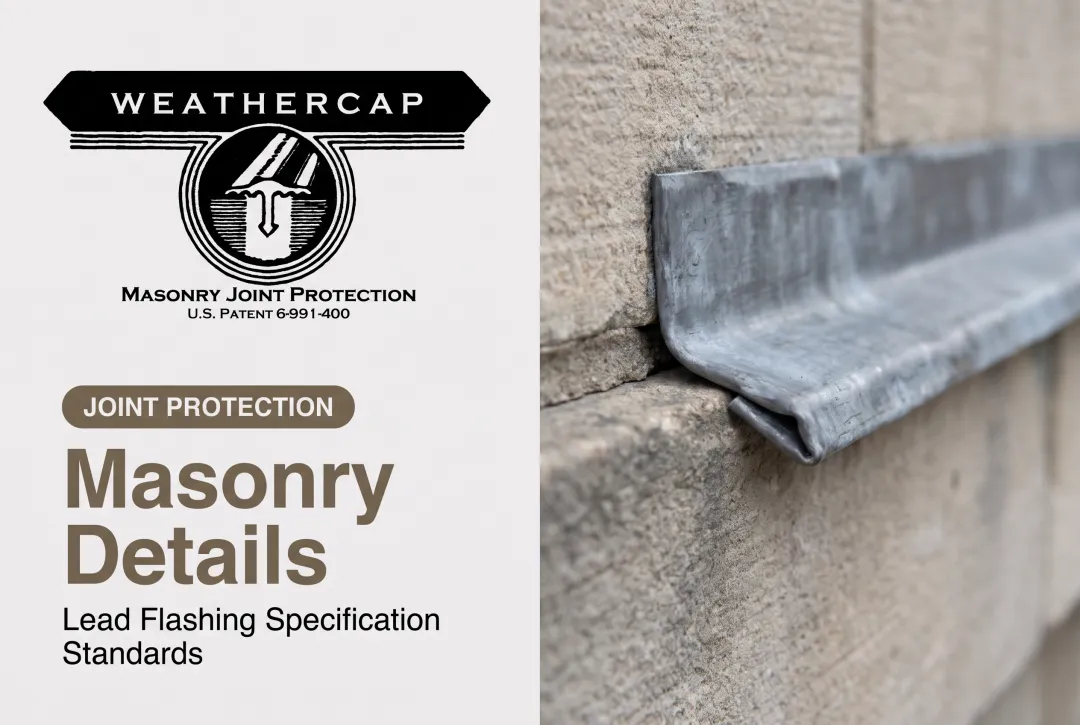
Weathercap's patented soft lead strip sits in the sealed joint and is pressed into the sealant bed. Once in place, it:
- Cuts the joint opening size roughly in half, so exposed sealant absorbs less movement
- Buffers stress through creep rather than resistance—lead's low tensile strength and elastic modulus let it reshape with the joint instead of tearing or springing back
The material also won't conduct heat or cold, and its surface oxidizes from silver-grey to a dead neutral grey that blends into surrounding masonry.

Weathercap covers common joint sizes in two configurations:
| Type | Configuration | Joint Size Range (I.D.) |
|---|---|---|
| Type A | Flat Cap | Under 3/8 in. to 1½ in. |
| Type B | 90° Cove Cap | Under 5/16 in. to 1¼ in. |
The system is specified in GSA Historic Preservation Technical Procedures (Document 07656-01). It has been used on the Washington Monument, the U.S. Supreme Court, the U.S. Capitol, the Smithsonian Institution, Grand Central Station, and multiple state capitols.
When specifying joint protection at copings, parapets, and wall junctions, match Type A or Type B to the joint profile and size range above.
Maintenance and Durability Considerations
Durability is masonry's biggest selling point, but it isn't automatic. The Brick Industry Association is clear on this: periodic inspection and maintenance are needed to maximize the life of brickwork, even though brick itself is inherently durable.
Common maintenance tasks include:
- Repointing deteriorated mortar joints
- Removing plant growth from wall surfaces
- Repairing weeps and flashing
- Replacing damaged wall ties
- Monitoring joint sealant condition

The National Park Service publishes detailed preservation briefs on repointing historic masonry and controlling unwanted moisture—core guidance for anyone managing an older building.
One principle matters more than any other: use repair materials that match the strength and flexibility of the original masonry. A mortar that's too hard or too rigid puts stress on surrounding units and can accelerate deterioration rather than stop it.
No verified study quantifies exactly how many years proper maintenance adds versus neglect. What's well-documented is the mechanism: catching moisture problems early prevents the cascading damage that turns a small repair into a full restoration.
Choosing the Right Material and Technique for Your Project
Selection comes down to three factors working together, not one criterion alone.
Climate exposure matters most. Wet, freeze-thaw regions demand materials and joint details that manage moisture aggressively. CMHA guidance even requires thawing frozen masonry units before placement in cold-weather construction. Adobe suits drier climates specifically because of its moisture sensitivity.
Building use dictates structural technique. Residential projects often suit load-bearing masonry, while commercial and seismic-zone work usually needs reinforced systems to meet code.
Budget and aesthetics round out the decision. Stone veneer delivers a natural-stone look at a fraction of solid stone cost. Glass block adds light without load-bearing capacity, within code limits.
Joint geometry, sealant compatibility, and regional code adoption all intersect in the final spec. Bring in a masonry professional or architect before you lock materials and detailing.
Frequently Asked Questions
What is masonry material?
Masonry material refers to any building unit, such as brick, stone, or concrete block, that's bound with mortar to construct a wall or structure. The term covers those bonded units as a group, not one product alone.
Is masonry different from concrete?
Concrete is one type of masonry material, not a separate category. Masonry is the overall construction method that includes concrete block, brick, stone, and other bonded units.
What is the strongest type of masonry?
Reinforced masonry, which embeds steel within the wall, generally offers the highest resistance to seismic and wind loads. Strength ultimately depends on unit properties, reinforcement, and design method together.
How long does masonry construction last?
Brick masonry often lasts about 100 years, and well-maintained structures can endure for centuries. Lifespan still hinges on installation quality and ongoing maintenance.
What causes masonry joints to fail?
Building movement and settlement cause "joint-checking," where sealant cracks and lets moisture in. Copings, parapets, and right-angle wall junctions face the highest stress and are most vulnerable.
Can masonry be repaired instead of replaced?
Yes. Repointing deteriorated mortar and adding joint protection over sealant can restore performance without full replacement, provided the underlying structure remains sound.