
Cracked mortar, failed caulk, and water infiltration rank among the most common (and costly) causes of masonry deterioration. Bulk water intrusion can rot sheathing and structural members behind the wall before anyone notices a problem from the street.
This guide covers what movement joints are, why they matter, the different types used in construction, placement guidelines, and how protective systems extend the life of sealant long after installation day.
Key Takeaways
- Movement joints let masonry expand, contract, and shift without cracking or letting water in
- Expansion, control, and isolation joints each solve a different movement problem
- Joint spacing follows established masonry guidelines, not guesswork
- Protecting sealant, not just installing it, determines how long a joint actually performs
- Routine inspection catches small failures before they become expensive repairs
What Are Building Movement Joints and Why Do They Matter?
A movement joint is an intentional gap built into floors, walls, and facades. It's designed to absorb structural movement so the surrounding masonry doesn't have to.
Four forces drive this movement:
- Thermal expansion/contraction — materials expand in heat and contract in cold, day after day
- Building settlement — foundations shift slightly as soil compresses under load
- Seismic activity — ground motion transfers stress directly into the structure
- Wind sway — tall buildings flex laterally under wind load
The Brick Industry Association notes that restrained temperature, moisture, elastic, settlement, and creep movement can crack masonry when the material has nowhere to go. Skip the joint, or size it too small, and you get a predictable failure chain: cracking, spalling, sealant failure, then water infiltration.

That last part is the expensive one. According to CMHA's masonry water-management guidance, bulk water intrusion and vapor drive can damage and rot sheathing and structural members behind the facade — damage that's invisible until it's severe.
On historic masonry, that same failure chain threatens irreplaceable fabric. The National Park Service's repair records for the Washington Monument describe work after seismic damage: removing loose stone, sealing cracked panels, patching stone, and repointing mortar joints.
Older buildings weren't always built with modern movement-joint standards. Retrofitting and protecting existing joints has become its own specialty as a result.
Types of Movement Joints in Construction
Not all movement joints do the same job. Mixing up the terminology in a spec leads to the wrong detail in the wrong place.
Expansion Joints
Expansion joints accommodate thermal expansion and contraction across large spans of brick masonry. They're a continuous separation running through the wythe, and in a true building expansion joint, through the wall assembly and underlying structure as well. Brick veneer relies heavily on these to prevent cumulative movement from cracking the facade.
Control Joints
Control joints manage shrinkage cracking in concrete and CMU. Instead of preventing cracks outright, they create a planned plane of weakness so cracking happens along a straight, predictable line rather than randomly across the wall. These joints tend to widen slightly as the material shrinks over time.
Isolation Joints
Isolation joints separate structural elements that move independently, such as a slab-to-wall connection. Their job is preventing load transfer between sections, not managing shrinkage or thermal change.
Soft/Sealant Joints in Masonry
Sealant-filled joints are the most common closure method in masonry facades, but they remain vulnerable to the elements. UV exposure, temperature cycling, and repeated joint movement wear sealant down over time.
NIST field studies found that roughly 50% of sealants fail within 10 years, and 95% fail within 20 years. Meeting ASTM C920 spec doesn't guarantee service life; it only defines sealant properties at installation.

How Often Are Movement Joints Needed in Brickwork and Masonry?
Spacing depends on the material, exposure, and expected movement, but the Brick Industry Association's Technical Note 18A gives useful benchmarks for brick veneer:
| Condition | Maximum spacing |
|---|---|
| Brickwork without openings | 25 ft (7.6 m) o.c. |
| Brickwork with multiple openings | 20 ft (6.1 m) o.c. |
| Parapets | Widen or add joints if spacing exceeds 15 ft (4.6 m) |
| Corners | Joint within 2 ft (600 mm) of the corner |

High-stress locations:
- Horizontal joints atop parapets and copings
- Right-angle wall junctions
- Openings, offsets, and setbacks
- Changes in backing material, support, or exposure
These are brick-specific benchmarks, not a universal rule for every masonry assembly. Design professionals and structural engineers still set exact joint locations, sizes, and frequency project by project. They match code guidance to the wall system, supports, and exposure on site.
Protecting Movement Joints: Why Sealant Alone Isn't Enough
Sealant closes the joint. It doesn't protect itself. UV exposure degrades the surface, temperature swings stress the bond line, and repeated joint movement eventually causes checking and cracking — well before the masonry itself shows any wear.
A protective joint system closes that exposure gap. It doesn't replace sealant; it shields the sealant from the environmental stress that breaks it down.
How WEATHERCAP® Works
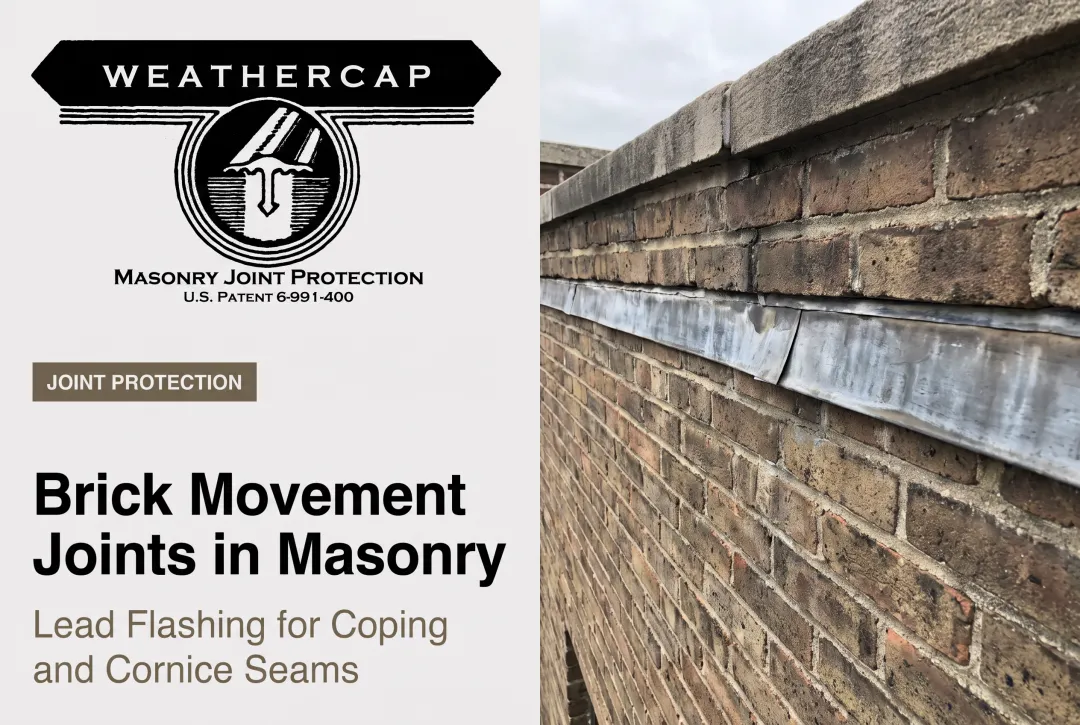
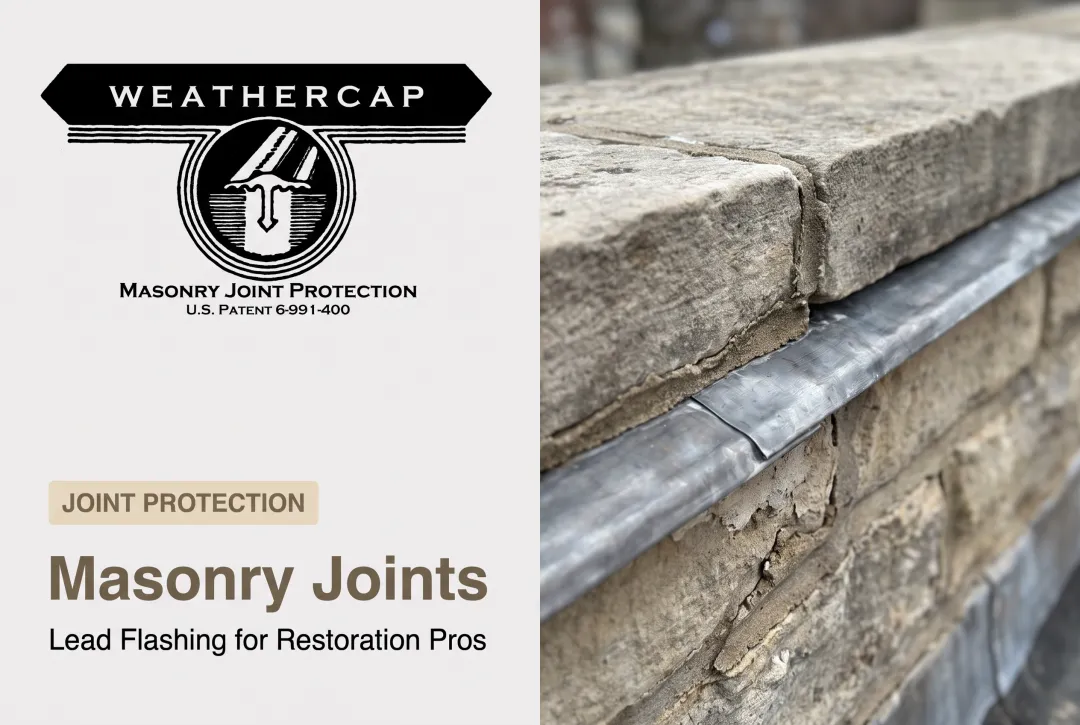
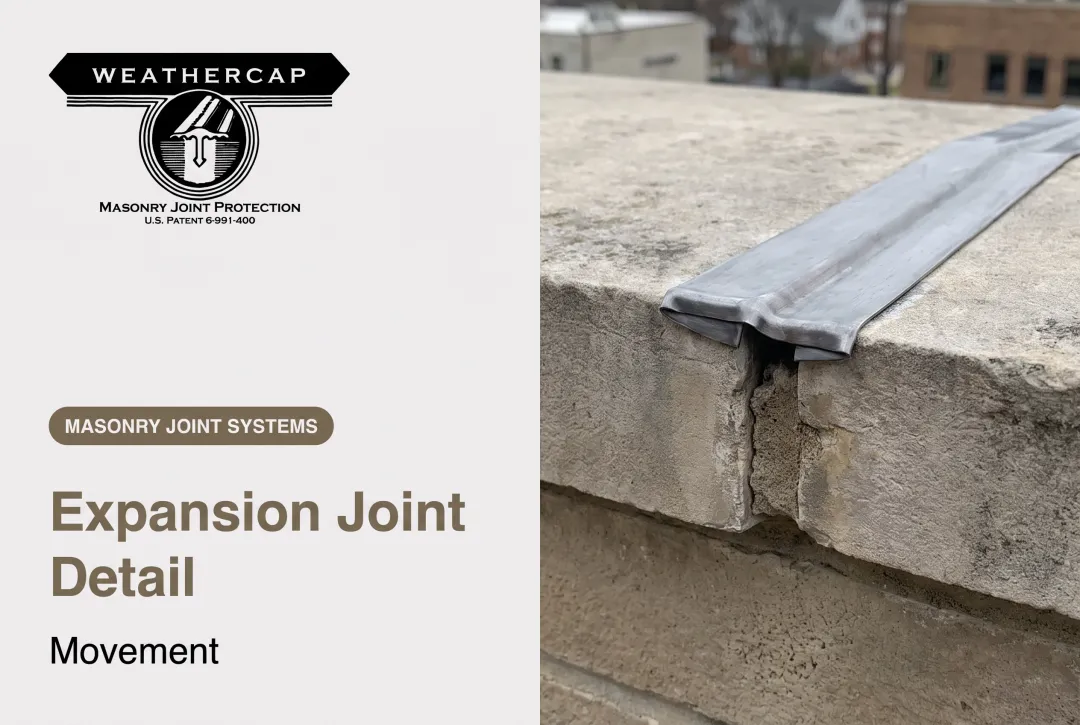
WEATHERCAP® is a patented soft lead strip (U.S. Patent 6991400) set into horizontal and vertical masonry joints and bedded directly in the sealant. Lead's low tensile strength, low hardness, and low elastic modulus let it creep with building movement, so the strip flexes without tearing or shearing.
Key properties:
- Cuts the effective joint opening that sealant must span by roughly half
- Resists corrosion, mold, and mildew in humid conditions
- Avoids thermal bridging — lead does not conduct heat or cold at the joint
- Oxidizes to a neutral grey that blends with most masonry; accepts paint
- Ships in 6-foot lengths as Type A (flat cap) or Type B (90° cove cap)

Where each type fits:
- Type A (flat cap): Coping tops, sides, and cross joints; runs across the coping and down the parapet face
- Type B (90° cove cap): Right-angle conditions where cornices, belt courses, or lintels meet a parapet or side wall
Specified on Federal Preservation Work
A soft lead strip system for weatherproofing vulnerable masonry joints appears in GSA Historic Preservation Technical Procedures (Document 07656-01), covering parapets, copings, balustrades, cornices, and belt-course ledges.
WEATHERCAP® has been used on the Washington Monument, the U.S. Supreme Court, the Smithsonian Institution, and more than 28 other nationally significant landmarks where long-term protection of historic masonry joints is required.
Installation and Maintenance Best Practices for Movement Joints
Getting a movement joint right, or protecting one properly, comes down to a few fundamentals:
- Measure accurately. Joint sizing accounts for the measured opening, anticipated movement (often via a scribe test), plus an additional ¼ inch allowance.
- Select materials for exposure. A parapet coping facing constant weather needs different treatment than a sheltered interior joint.
- Place joints at stress points. Corners, openings, and material transitions concentrate movement. Don't just space joints evenly along a blank wall.
- Rake and clean before resealing. Any retrofit requires removing old caulk and debris so the new sealant bonds properly.
- Inspect routinely. Catching sealant cracking or displacement early prevents water from ever reaching the substrate.

Professional installation costs more upfront than a quick caulk job, but it reduces long-term repair costs compared to undersized or improperly placed joints. Once water reaches the structure behind the wall, those savings disappear fast.
Frequently Asked Questions
What is the purpose of a movement joint in a concrete slab?
Movement joints in concrete slabs relieve stress from shrinkage, thermal change, and settlement. Without them, the slab cracks unpredictably instead of at a controlled location.
How often do you need a movement joint in brickwork?
Spacing depends on brick type, exposure, and engineering specification. General guidance points to roughly 20–25 feet intervals. A structural engineer or architect sets the exact intervals for your project.
What are movement joints in a building?
Movement joints are designed gaps in floors, walls, and facades that let a structure expand, contract, or shift safely. They prevent the cracking and damage that restrained movement would otherwise cause.
How do you protect the sealant inside a masonry movement joint from failing prematurely?
Sealant alone degrades from UV exposure and repeated movement. Protective cover systems, like a soft lead strip bedded into the joint, shield the sealant from direct weathering while accommodating ongoing movement.
Can movement joints be repaired without full reconstruction?
Yes. Most joint failures can be addressed by raking out old sealant, resealing, and adding a protective cover system, not by removing or rebuilding the surrounding masonry.