
Get the detail wrong and the consequences show up fast: cracked veneer, water intrusion behind the wall, and callbacks that cost far more than the joint would have. This guide breaks down five practical tips for architects and masonry contractors who want joints that actually hold up.
Key Takeaways
- Calculate joint spacing and width with BIA formulas; verify with a qualified engineer
- Pair movement-rated sealant with correctly sized backer rod to prevent joint failure
- Protective systems like WEATHERCAP® shield sealant from weathering and movement stress
- Prioritize corners, copings, and terminations—where most masonry joint failures start
- Precise terminology and code compliance prevent costly specification errors
Tip 1: Calculate Correct Joint Spacing and Width
Guessing at joint spacing is how cracked masonry happens. The Brick Industry Association (BIA) publishes a formula specifically for this in BIA Technical Note 18A:
Se = (wj × ej) / 0.09
Where Se is spacing between expansion joints in inches, wj is joint width in inches, and ej is sealant/backer compressibility as a percentage.
Worked example: With a ½-inch joint width and 50% compressibility, Se = (0.5 × 50) / 0.09 = 278 inches, or 23 feet 2 inches.

Vertical vs. Horizontal Joints
These aren't interchangeable:
- Vertical (control/expansion) joints relieve lengthwise thermal and moisture movement along a wall plane
- Horizontal (bed joint/coping) joints address movement at shelf angles, copings, and support transitions
- Treating them as interchangeable leaves one direction of movement unrelieved
BIA's prescriptive guidance caps vertical spacing at 25 feet for brick veneer without openings, and 20 feet with multiple openings. At parapet tops, limit spacing to 15 feet unless joint width is adjusted.
These are illustrative BIA figures, not a formal TMS 402 table. TMS 402/602-22 requires accommodation of movement but doesn't publish a universal numeric spacing chart. Always confirm final spacing against project-specific engineering calculations.
Skip this step and stress concentrates at the weakest point in the wall. That's where cracking starts, and where water eventually finds its way in.
Tip 2: Choose the Right Sealant and Backer Rod System
Not every caulk qualifies as a joint sealant. Ordinary acrylic latex dries hard, shrinks, and can't accommodate ongoing movement. Per BIA guidance, specify sealants meeting ASTM C920, Grade NS, Use M, Class 50 (Class 25 as an alternate): typically silicone, polyurethane, or polysulfide formulations.
Backer Rod Geometry Matters
Closed-cell foam backer rod does three jobs:
- Controls sealant depth-to-width ratio (roughly 1:2, per industry guidance)
- Prevents three-sided adhesion that restricts movement
- Establishes consistent tooling geometry
Size the rod about 25% larger than the joint opening. Sealant depth should run about half the joint width, with a ¼-inch minimum. Tool it dry against the rod. Wet tooling aids like soapy water aren't recommended by manufacturers.

Why Sealant Alone Often Isn't Enough
Sealant carries the full burden of movement, UV exposure, and weathering on its own. Over time, that takes a toll. Even a well-installed joint degrades faster without protection.
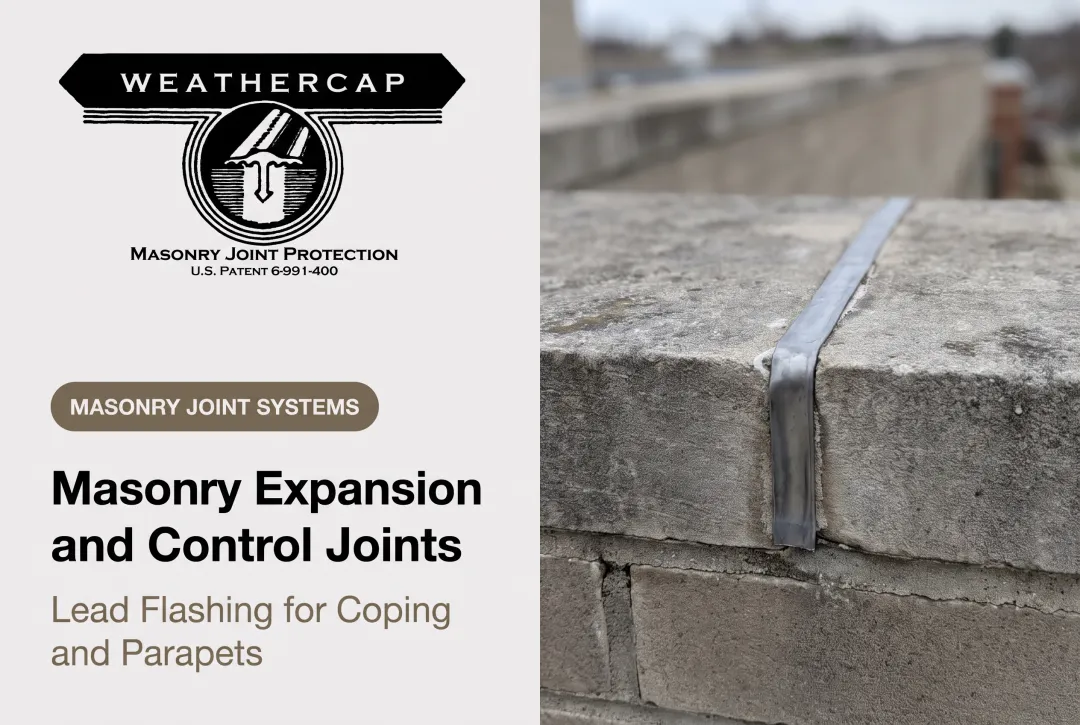
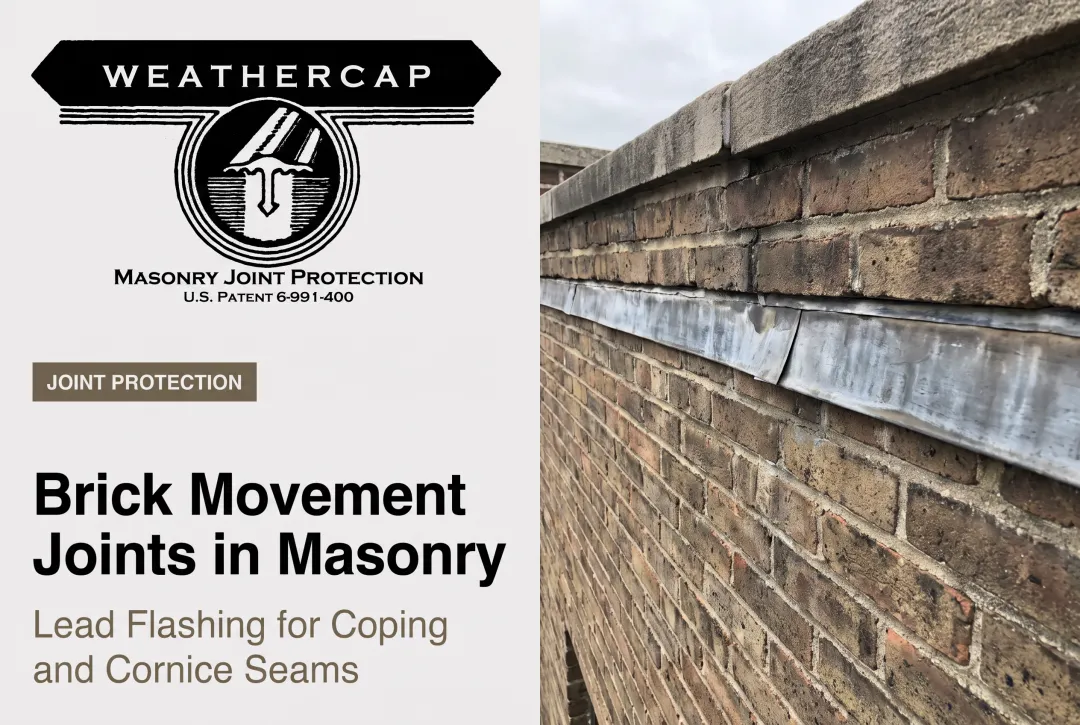
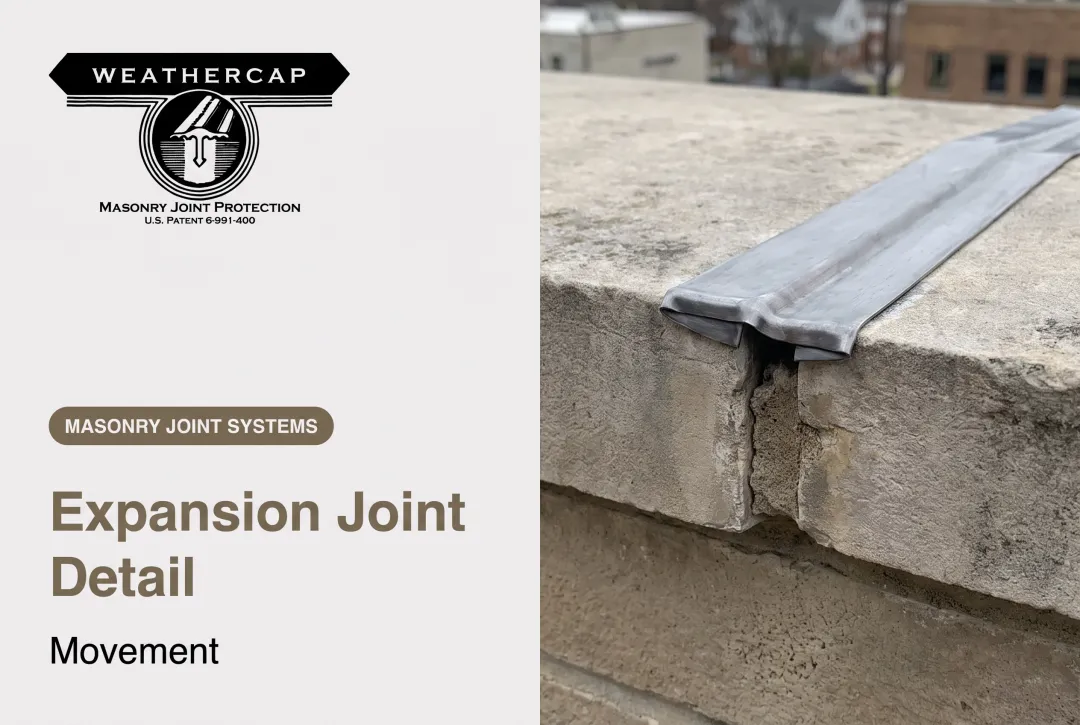
A protective adjunct helps share that load. WEATHERCAP®, a patented soft lead strip, sits between sealant layers in the joint. It's set and bedded in the caulking compound, occupying part of the opening while shielding the sealant beneath.
That setup cuts the effective joint opening the sealant must span by roughly half. It has been specified on projects including the Washington Monument and the U.S. Supreme Court.
When installing with the strip, seat the backer rod ¼ inch below the anchor shaft tip and keep at least ¼ inch of sealant between rod and shaft.
Tip 3: Detail Joint Terminations and Corner Conditions Correctly
Corners and copings are where masonry joints fail most often. Right-angle wall junctions, parapet transitions, and coping terminations concentrate stress in ways a straight run of wall never sees.
The Brick Industry Association (BIA) sets clear spacing rules for these stress points:
- Place a vertical expansion joint within 2 feet of a corner on at least one side
- Joint the second side within about 10 feet
- Continue vertical joints through parapets, with top spacing no more than 15 feet
Flexible Materials at Transition Points
Rigid materials tear or shear when stressed from two directions at once. The joint system has to flex under that load without breaking the seal or pulling away from the adhesion faces.
WEATHERCAP® covers both geometries with two cap configurations:
- Type A (Flat Cap): flat terminations such as copings, cornices, belt courses, sills, and lintels (sizes A-2 through A-8; joints under 3/8" up to 1½" I.D.)
- Type B (90° Cove Cap): right-angle terminations where cornices or water tables meet a parapet or side wall (sizes B-2 through B-8; joints under 5/16" up to 1¼" I.D.)

Match flat caps to flat terminations and cove caps to inside corners so these high-stress points stay sealed.
Tip 4: Account for All Sources of Building Movement
Movement joints need to handle more than one stressor at once. The main drivers:
- Thermal expansion/contraction: brick moves at roughly 4 × 10⁻⁶ in./in./°F, per BIA Technical Note 18
- Moisture-related shrinkage: concrete masonry typically moves 0.0002 to 0.00045 in./in. under ASTM C426 testing
- Structural settlement: foundations and framing shift over time
- Seismic activity: sudden multi-directional loads on the joint

South-facing walls absorb more direct solar gain. Dark-colored masonry on those elevations can run well above ambient; BIA notes surface readings up to 140°F, versus a typical 100°F design range. Detail higher-exposure elevations for that extra thermal swing.
Movement rarely happens in a single plane. A coping joint can take lateral thermal movement and vertical settlement at the same time. Systems built for multi-directional movement hold up better long-term than single-axis sealant alone.
Tip 5: Follow Code Requirements and Avoid Common Specification Errors
Loose terminology creates ambiguity in contract documents. Per current CMHA guidance:
| Term | Function |
|---|---|
| Control joint | Manages CMU shrinkage cracking |
| Expansion joint | Accommodates clay masonry unit expansion |
| Movement joint | Umbrella term covering multiple movement sources |
| Isolation joint | Prevents load transfer between sections |
"Movement joint" is now the preferred general term. Using it consistently avoids confusion between trades and reviewers.
The Reinforcement Mistake
One of the most common errors: running horizontal joint reinforcement straight through a movement joint. That reinforcement restrains the exact movement the joint is designed to allow, and cracking follows. CMHA guidance is clear: reinforcement should stop at the joint unless structurally required otherwise.
Two more specification pitfalls to watch for. Grout and mortar must meet ASTM C476 and ASTM C270, but neither replaces elastomeric sealant per ASTM C920:
- Substituting plain concrete or standard mortar for the movement joint itself
- Specifying unproven or undocumented products with no technical support
WEATHERCAP®'s inclusion in GSA Historic Preservation Technical Procedures (Document 07656-01) offers architects a code-recognized reference point: a specification with documented installation history rather than a generic catalog listing.
Why Experienced Professionals Trust Proven Systems Like WEATHERCAP®
WEATHERCAP®'s soft lead strip shields sealant from UV exposure, moisture cycling, and movement stress. That cover extends joint life and stretches the time between sealant repairs—maintenance still happens, just far less often.
The track record backs this up. Beyond the Washington Monument, Supreme Court, and Smithsonian, WEATHERCAP® has been specified on:
- The U.S. Treasury Building and Arlington National Cemetery
- Grand Central Station and the Metropolitan Museum of Art
- Multiple state capitols, including Pennsylvania, Georgia, and North Dakota
- Cornell, Brown, and Johns Hopkins Universities
Contractors on tight schedules get a logistics edge as well. WEATHERCAP® ships in 6-foot lengths within 48 hours of order placement, so restoration work does not stall waiting on a specialty joint product.
Frequently Asked Questions
How far apart should movement joints be?
BIA guidance offers a rule of thumb of about 20–25 feet for vertical joints in brick veneer. Treat that as illustrative only—final spacing must be calculated for project conditions by a qualified engineer.
What is the purpose of a movement joint?
Movement joints relieve stress caused by thermal cycling, moisture-related shrinkage, and structural settlement. Without them, that stress concentrates and leads to cracking and water infiltration.
Do you need movement joints in concrete block (CMU)?
Yes. Concrete masonry units shrink as they cure and dry, and codes require control joints at set intervals to manage that shrinkage and prevent random cracking.
What is the difference between a control joint and an expansion joint?
Expansion joints primarily accommodate clay masonry unit growth, while control joints manage CMU shrinkage cracking. "Movement joint" has become the preferred umbrella term for both.
What happens if movement joints are installed incorrectly?
Poorly detailed joints lead to cracked masonry, premature sealant failure, and water penetration behind the wall assembly. Left unaddressed, those failures drive costly repairs and callbacks.